
Key Takeaways
Stairlift batteries commonly last several years, but Florida heat, charging habits, and daily use can affect that timeline. A few simple checks can help you recognize problems before the lift becomes unreliable.
- Many stairlift batteries last about two to five years, depending on use and care.
- Leaving the stairlift connected at its charging position usually supports battery health.
- Heat, humidity, rain, and salt air can increase wear, especially on outdoor equipment.
- Slower travel, warning sounds, and unexpected stops can indicate a battery or charging problem.
- Correct replacement batteries and professional service help keep the lift safe and dependable.
Understanding how long stairlift batteries last
If you are asking, “how long do stairlift batteries last,” the practical answer is usually measured in years rather than months. A typical range is about two to five years, although the actual service life depends on how often you use the lift, how it is charged, and the conditions around it. Your stairlift may need attention sooner if it works hard every day or sits in a hot, damp location. Battery age alone does not tell the whole story.
Typical battery lifespan under normal use
Under ordinary residential use, many stairlift batteries provide dependable service for roughly two to five years. Some may last longer with light use and good charging habits, while frequent trips and demanding conditions can shorten the interval. Treat this range as a planning guide, not a promise for every model or household.
A simple record can make the range easier to understand. Note the installation date, the first signs of weaker performance, and whether the battery has already been replaced. The table below offers a general way to think about common patterns.
| Use pattern | General planning expectation | What to watch for |
|---|---|---|
| Light household use | Several years may be possible | Longer charging or reduced travel |
| Regular daily use | Often around two to five years | Slower movement or more frequent warnings |
| Heavy daily use | Replacement may come sooner | Noticeable loss of range or power |
| Outdoor or harsh conditions | Service life may be reduced | Corrosion, moisture, or charging problems |
These are broad expectations rather than model specifications. If your battery is performing normally, there is no need to replace it simply because it has reached a particular age; if performance has changed, have the complete charging system checked.
Why usage patterns affect battery life
Every trip uses some of the battery’s stored energy. A person who makes several round trips each day places a different demand on the batteries than someone who uses the lift once or twice. Long periods of inactivity can also be unhelpful if the lift is switched off or left away from its charging point.
The rider’s routine, the length of the staircase, and the number of trips all matter. A battery that seems fine during occasional testing may show weakness when the lift is used repeatedly in a short period. That is why your everyday pattern is more useful than a generic calendar estimate.
How the stairlift model and battery system matter
Stairlifts do not all use the same battery arrangement, charger, or contact design. Straight and curved rails can have different layouts, and outdoor equipment must cope with conditions that an indoor lift does not. The correct maintenance instructions come from the equipment documentation and the service provider familiar with that model.
If you are choosing equipment for a new installation, the staircase layout and intended use should be assessed together. NewDay Mobility provides straight, curved, and outdoor stairlift options, with selection based on the staircase, mobility needs, and installation requirements. Ask for current model information rather than assuming that one battery schedule applies to every lift.
Battery lifespan compared with overall stairlift lifespan
Battery age alone does not determine the correct replacement time. Follow the manufacturer’s guidance and your technician’s recommendation, and have the complete charging system checked if performance changes.
A battery replacement is usually a smaller decision than replacing an entire lift. However, repeated failures or increasingly difficult repairs deserve a broader assessment. Your technician can explain whether continued service, a different configuration, or another home mobility solution makes practical sense.
How Florida conditions can affect battery performance
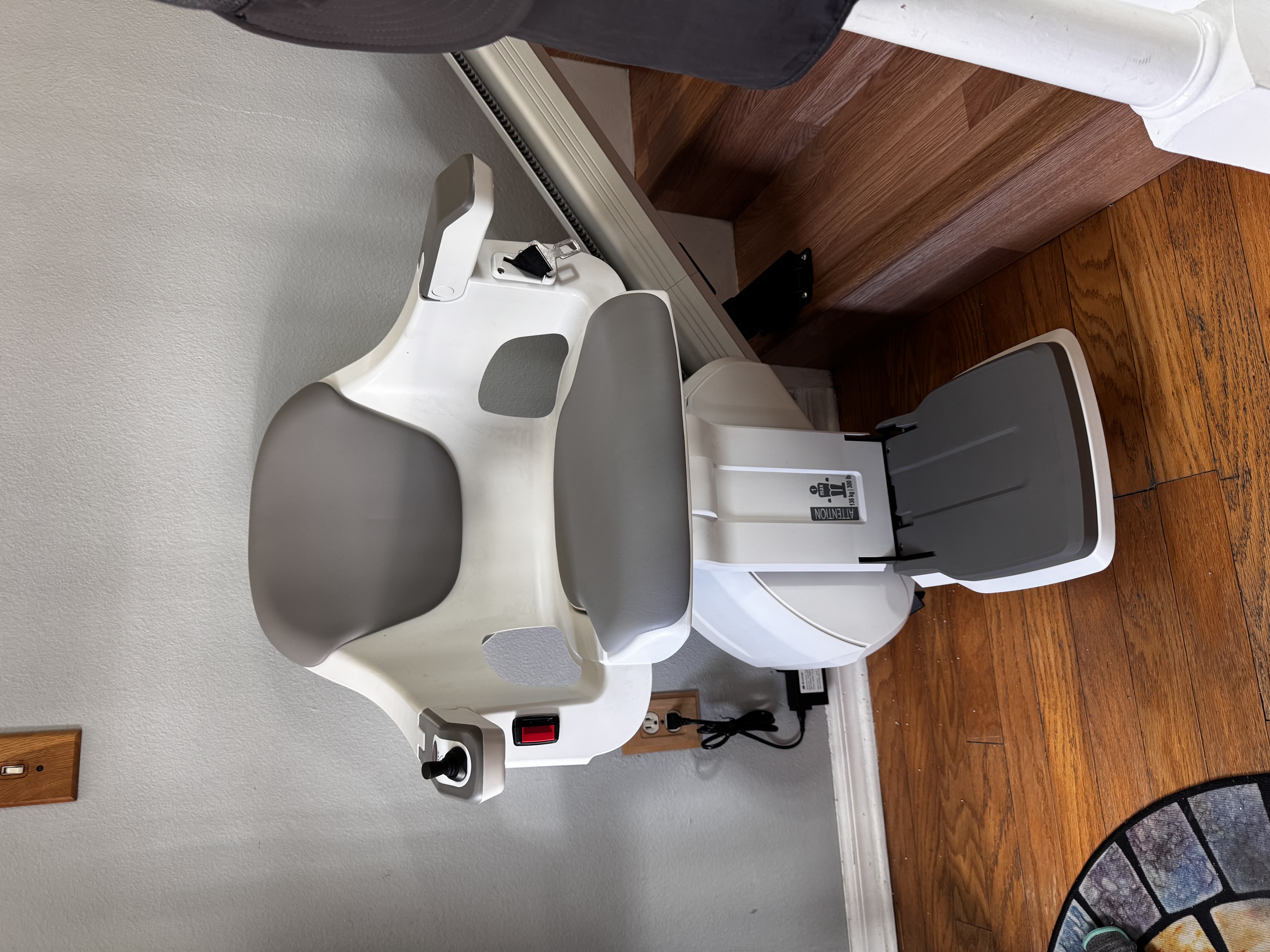
Florida weather can affect stairlift care even when the equipment is inside the home. Heat and humidity may put extra stress on electrical components, while outdoor lifts face rain, airborne moisture, and, in coastal areas, salt air. Power interruptions during storms can also change how often the lift is able to recharge. The right response depends on whether your stairlift is indoors or outside and how it is installed.
Heat and humidity in indoor installations
An indoor stairlift is protected from direct rain, but it may still be exposed to warm rooms, poor ventilation, or humid air. Avoid placing belongings over ventilation areas or around the charger, and do not use household sprays or liquids near electrical contacts. A clean, dry environment gives the charging equipment a better chance to work as intended.
You should also pay attention to seasonal changes. A lift that performs normally in a mild winter may sound different or charge more slowly during a hot summer. If the change persists after the room returns to normal conditions, arrange a service check instead of guessing that the battery is the only cause.
Outdoor stairlifts and exposure to the elements
Outdoor stairlifts face a more demanding environment. Rain, direct sunlight, humidity, leaves, dirt, and salt air can affect exposed surfaces and charging points. Keeping the area clear and following the manufacturer’s cover or parking instructions can reduce avoidable exposure, but no homeowner should substitute an improvised cover for approved equipment.
NewDay Mobility offers outdoor stairlift solutions for exterior staircases. If you are comparing a lift for a porch, garage, entrance, or another outdoor route, discuss the local conditions and maintenance expectations during the assessment. A Florida outdoor stairlift guide can also help you consider weather exposure, access needs, and ongoing care before choosing equipment.
Managing batteries during Florida power outages
Battery-powered stairlifts can remain useful during a power interruption, but their available travel depends on the battery’s condition and how much charge was stored before the outage. Do not assume that a partially charged or aging battery will provide the same backup as a newer, fully charged one. If severe weather is expected, park the lift in its usual charging position when safe to do so.
After an outage, check whether household power has returned and whether the charger’s indicator appears normal. Avoid repeatedly running the lift up and down simply to test it, especially if someone may need it for essential access. If the lift will not recharge after power is restored, contact a qualified service provider.
When climate-related wear requires professional advice
Surface dirt is one thing; corrosion, moisture inside equipment, recurring charging failures, or unusual sounds require more care. Do not open electrical housings or attempt to dry internal components with household tools. A professional can inspect the battery, contacts, charger, wiring, and other relevant parts without turning a small issue into a safety concern.
For Florida homeowners, a stairlift maintenance schedule can help you think beyond battery age. Frequent use, outdoor exposure, and equipment design may all affect how often service is appropriate. When conditions are unusual, an inspection is more useful than relying on a standard replacement date.
Charging habits that help batteries last longer
Charging behavior is one of the simplest parts of stairlift ownership to manage. Most battery-powered lifts recharge when they are parked at a designated charging position and connected to household power through the charging system. If the lift is routinely left elsewhere, switched off, or unable to make contact, the batteries may gradually lose their ability to provide normal travel. Small daily habits can prevent many avoidable problems.
How the stairlift charging system works
A stairlift generally uses household power to run a charger, which then supplies a low-voltage charge through the designated charging point. Depending on the model, charging contacts may be located at one or more parking positions or along part of the rail. Your owner’s instructions should show exactly where the lift needs to stop.
The charger may have an indicator light, but that light does not replace a performance check. A normal-looking indicator alongside a weak battery can point to a contact, battery, or system issue. If you are unsure where the charging point is, ask the installer to demonstrate it again.
Why the lift should remain connected when parked
Leaving the lift at its normal charging position allows the system to maintain the battery between trips. This is especially helpful when you use the stairlift only occasionally, because infrequent use does not remove the need for routine charging. Make parking the lift part of the same habit as returning a mobility aid to its usual place.
Avoid switching off the stairlift unless the instructions specifically tell you to do so. If the lift is parked away from its charging point for convenience, it may be unavailable when you need it. Consistent charging matters more than trying to predict the exact day a battery will weaken.
What to check if the battery is not charging
If you suspect the battery is not charging, begin with simple observations rather than removing covers. Confirm that the home has power, the charger is connected, and the lift is fully positioned at the designated contact point. Look for obvious dirt or obstruction, but do not scrape contacts or use liquid cleaners unless the equipment instructions specifically permit it.
A short checklist can help you describe the problem accurately to a technician:
- Is the lift parked at the correct charging point?
- Does the charger show its usual indicator light?
- Are warning sounds or messages appearing?
- Did the problem begin after an outage, cleaning, or unusual weather?
These details can help separate a positioning issue from a charger or battery fault. If the lift still does not charge, stop repeated testing and arrange service before the battery becomes completely depleted.
Safe charging practices for homeowners
Keep the charger and nearby outlet accessible, dry, and free from clutter. Do not use an extension cord or substitute charger unless the manufacturer or a qualified technician has approved that arrangement. Never connect a battery that does not match the equipment’s specifications simply because it appears to fit.
If the charger becomes unusually hot, smells burned, makes an unfamiliar sound, or shows visible damage, disconnecting it may be appropriate if you can do so safely. Then seek professional advice. Safe charging is not about doing more yourself; it is about avoiding conditions that can damage the equipment or put you at risk.
Signs that stairlift batteries may need replacement
Battery weakness often develops gradually. You may notice that the lift travels fewer times between charges, moves less confidently, or gives a warning before it stops working altogether. These signs can overlap with charger, contact, electrical, or mechanical problems, so they should be treated as clues rather than a diagnosis. Pay attention to changes from the lift’s usual behavior.
Reduced travel distance or slower performance
A stairlift that once completed several trips comfortably may begin to slow down or lose power sooner. It might stop partway through a route, require longer charging, or perform normally in one direction but struggle after repeated trips. Such changes are more meaningful when they are new and consistent.
Do not wait for a complete failure if the lift is used for essential access. Write down when the change occurs and whether the lift was fully parked and charged. That information can help a service professional test the system more efficiently.
Battery warning lights, sounds, or error messages
Beeping, flashing indicators, and error messages vary by model. Some alerts relate to the battery, while others may point to a control, safety sensor, charger, or parking position. Your manual should explain the basic meaning of the alert, but unfamiliar or repeated warnings deserve attention.
Never silence a warning and continue using the lift as if nothing happened. Record the pattern, including when it starts and whether it clears after parking. A technician can then compare the alert with the equipment’s diagnostic information.
The stairlift stopping away from its charging position
Stopping away from a charging point can leave the lift unable to recharge for the next trip. It may happen because the battery is weak, but it can also reflect a control problem, an obstruction, a safety sensor, or a failure to reach the correct parking position. Keep the stairs and rail clear while you observe the problem.
If the user cannot safely reach another level without the lift, arrange assistance rather than attempting a risky reset. A stairlift should be assessed before repeated stops become a routine part of use.
Distinguishing battery problems from charger or electrical faults
A weak battery and a faulty charger can look similar from the seat. The lift may not hold a charge, may show a warning, or may stop sooner than expected in either case. A complete inspection should include the batteries, charger output, contacts, power supply, and relevant connections.
Avoid buying replacement batteries based only on a brief symptom. Replacing good batteries will not solve a failed charger, and a new charger will not correct batteries that have reached the end of their service life. Testing the full charging path is the safer approach.
What short battery life may indicate
If batteries last much less time than expected, age may be only part of the explanation. The lift may not be reaching its charging contacts, the charger may be failing, or the equipment may be working in unusually hot or damp conditions. Short life can also follow long periods without proper charging. Looking for the cause helps prevent the same problem after replacement.
Infrequent use and extended periods without charging
A stairlift that is rarely used still needs to remain connected as directed. Leaving it switched off for weeks or parking it away from the charging point can allow the batteries to discharge deeply. Repeated deep discharge may reduce useful battery life, even when the lift makes only a few trips.
If you leave your Florida home seasonally, ask your service provider for model-specific storage and charging instructions. Do not assume that simply turning off the main switch is the best approach. The correct procedure may depend on the lift and charger design.
Blocked charging contacts or connection issues
Dust, debris, oxidation, or a misaligned parking position can interrupt the connection between the lift and its charger. Outdoor installations may face more exposure, but indoor equipment can also develop contact problems over time. A lift that charges only when parked in a very precise position should be checked.
You can keep the area around the parking point clear and report visible damage, but do not bend contacts or dismantle the charging assembly. Small parts can be easy to damage, and a poor connection may create heat or intermittent charging.
Aging batteries versus a failing charger
Battery age is a useful clue, not a complete answer. If both batteries were installed at the same time and performance declines together, replacement may be reasonable; if a new battery weakens unusually quickly, the charger or another part of the system deserves investigation. A technician can measure the relevant components rather than relying on appearance.
This is also why replacing batteries as a matched set may be recommended for some systems. The exact approach depends on the model and the manufacturer’s instructions. Use the service record and test results to guide the decision.
When repeated battery failure points to a service issue
Repeated replacements within a short period are a reason to pause. The pattern may indicate charging-contact damage, a power issue, unsuitable operating conditions, or a component that is placing excess demand on the batteries. Simply installing another set without finding the cause can lead to more expense and another interruption.
Ask for a written explanation of what was tested and what was replaced. Clear records make it easier to notice patterns and determine whether the issue is limited to the battery system or requires wider stairlift service.
Replacing stairlift batteries safely
Battery replacement is a routine service task, but it is still an electrical and equipment-handling job. The correct battery must match the stairlift system, and the installation should leave the lift charging and operating as intended. If you are uncertain about the model or the condition of the charger, professional help is the sensible choice. A low-cost shortcut can create a larger reliability problem.
How to confirm the correct replacement battery
Start with the stairlift model, serial information, existing battery details, and the owner’s manual. Do not rely on size or appearance alone. A replacement should match the required voltage, type, connection, and system specifications identified for that equipment.
A service provider may also confirm whether both batteries or all batteries in the system should be replaced together. Before ordering, ask for the exact part information and whether the quoted work includes testing the charger and charging contacts.
Why model-specific compatibility matters
Different stairlifts can use different battery arrangements and charging systems. A battery that fits inside the carriage may still be unsuitable electrically or may not work correctly with the charger. Curved, straight, and outdoor configurations may also have different service considerations.
Equipment selection is similarly specific at the installation stage. NewDay Mobility assesses the staircase, rider needs, product availability, and installation requirements when helping homeowners consider mobility equipment. If you are still deciding whether a repair or replacement is sensible, request a current evaluation rather than choosing from a generic battery listing.
What homeowners should know about battery handling
Batteries should be handled according to the manufacturer’s instructions. Keep them away from heat, flames, moisture, and metal objects that could bridge the terminals. Do not puncture, crush, open, or place stairlift batteries in household trash. Ask your service provider or a local battery-recycling facility about proper disposal.
If a battery is swollen, leaking, cracked, unusually hot, or has a strong chemical smell, do not use or transport it casually. Keep people away from the area and seek qualified guidance. Children and pets should not have access to replacement or used batteries.
When to use professional stairlift service
Professional service is appropriate when the lift is stopping unexpectedly, the charger is damaged, the battery compartment is difficult to access, or the cause of the problem is unclear. It is also wise when the stairlift is needed every day and a failed repair would leave someone without safe access. The technician can replace the battery and test the system as a whole.
NewDay Mobility provides stairlift service and repair, along with professional installation and continued service after installation. When you contact a provider, share the model, symptoms, warning codes, and any recent outage or weather exposure. That preparation can make the visit more focused.
Planning maintenance and battery replacement in Florida
Battery care works best as part of a broader maintenance plan. Florida homeowners may need to account for heavy use, seasonal absences, outdoor exposure, storm-related outages, and the needs of a family member who depends on the lift. Planning ahead is less stressful than waiting for a failure on a day when the stairs are unavoidable. It also gives you time to compare repair, replacement, and accessibility options.
Keeping a record of charging and performance changes
Write down the installation date, battery replacement date, service visits, warning messages, and noticeable changes in speed or travel distance. Include whether the lift was indoors or outdoors and whether a power outage or unusually hot period came before the problem. A brief log can be more useful than trying to remember several months of symptoms.
Keep the model information and service contact in an easy-to-find place. If an adult child or caregiver helps manage the home, share the basic charging routine and warning signs with that person as well.
Scheduling inspections before a battery emergency
An inspection is especially useful when the battery is older, the lift is used heavily, or performance has started to change. Outdoor equipment and lifts in homes with frequent humidity or salt-air exposure may need closer attention. Schedule service before a planned period of high use, such as when a family member will be staying in the home.
NewDay Mobility serves homeowners throughout its Florida service area, including counties such as Orange, Polk, Volusia, Broward, and Palm Beach. Availability can depend on location, equipment, and scheduling, so confirm service coverage when you call. An inspection can address more than the battery and help you plan responsibly.
Questions to ask about service, warranty, and replacement coverage
Before authorizing work, ask what the inspection includes, which parts are being replaced, and whether the batteries and labor have separate coverage. If the stairlift is still under a warranty program, confirm the exact terms for your model and component. Coverage can vary, so avoid relying on a general statement about warranties.
It is also reasonable to ask for the expected lead time, the service area, and what happens if the same fault returns. For broader planning, a Florida stairlift cost guide can help you identify the factors that influence pricing, while a written quote clarifies your specific installation or repair scope.
When a stairlift upgrade or alternative mobility solution may be appropriate
A battery replacement may be all you need, but not always. Consider a broader assessment if repairs are becoming frequent, the staircase has changed, the rider’s mobility needs are different, or the current layout no longer feels comfortable. Straight and curved stairlifts, outdoor lifts, vertical platform lifts, and ramps each suit different home access challenges.
The goal is not to replace working equipment unnecessarily. It is to find a safe, practical way to move through the home and outside areas. Discuss the staircase, transfers, landing access, budget, and expected use with a qualified mobility professional before making a change.
Conclusion
Knowing how long stairlift batteries last helps you plan, but regular charging, attention to Florida conditions, and timely service matter just as much as the calendar. If your lift is slowing down, warning you, or failing to recharge, record what you are seeing and arrange an inspection rather than waiting for a complete stop. NewDay Mobility can help you review stairlift service and home mobility options throughout its Florida service area; request a consultation to discuss your situation and current availability.
Frequently Asked Questions
How long do stairlift batteries usually last?
Many stairlift batteries last about two to five years, although daily use, charging habits, climate, and the equipment itself can shorten or extend that range. “Follow the manufacturer’s guidance and your technician’s recommendation, and arrange an inspection if performance changes.”
Should a stairlift stay plugged in all the time?
In most systems, the lift should remain at its designated charging position when parked, following the manufacturer’s instructions. Keeping it connected helps maintain charge between trips, particularly when the stairlift is used infrequently.
Can Florida heat shorten stairlift battery life?
Heat and humidity can contribute to wear, especially when equipment is installed in a poorly ventilated or exposed area. Keep the charger and parking point clear and dry, and arrange service if performance changes during hot weather and does not return to normal.
Do outdoor stairlifts need more battery maintenance?
Outdoor stairlifts face rain, sunlight, humidity, dirt, and possibly salt air, so they may require closer observation and more frequent professional attention. Follow the equipment’s care instructions and report corrosion, moisture, or charging problems promptly.
What are the first signs of a failing stairlift battery?
Common clues include reduced travel distance, slower movement, longer charging, warning sounds, or stopping before reaching the usual parking point. These symptoms can also come from the charger or contacts, so a complete test is preferable to guessing.
Can I replace stairlift batteries myself?
Because battery replacement involves electrical connections, model-specific parts, and safety testing, using a qualified stairlift technician is generally recommended. Follow the manufacturer’s instructions and do not install batteries based on size or appearance alone.
What should I do if my stairlift stops during a power outage?
Avoid repeated trips that may drain the remaining charge. If it is safe, follow the manual’s instructions for the outage and arrange assistance for the rider. Once power returns, confirm that the lift is charging normally and seek service if it does not recover.