
Key Takeaways
Choosing between a straight vs. curved stairlift starts with your staircase, but it should also reflect your mobility needs, home layout, budget, and plans for the future.
- Straight stairlifts are generally suited to one uninterrupted flight of stairs.
- Curved stairlifts are designed for turns, landings, curves, and complex layouts.
- Outdoor stairlifts can help connect exterior areas such as entrances, porches, or garages.
- Installation timing and cost depend on the equipment, staircase, location, and preparation required.
- A professional assessment helps ensure the stairlift and rail are properly matched to your staircase.
Understanding the difference between straight and curved stairlifts
The shape of your staircase is the first practical distinction between these two options. A straight lift follows one continuous rail, while a curved lift uses a rail designed around the individual staircase. Your decision may also depend on transfers, available landing space, where you need to enter and exit, and how the stairs are used by other people in the home.
How straight stairlifts fit standard staircases
A straight stairlift is typically considered for a staircase with no turns, curves, or intermediate landings. Its rail follows the direct path from one level to the other, making it a straightforward option for many standard indoor staircases. You can review the basic approach on this page about straight stairlifts, then compare the details with your own staircase rather than assuming that every straight-looking flight is identical.
The rail still needs to be measured and installed correctly. Stair width, the position of the bottom and top landings, and available clearance can affect how the lift works in daily use. A home assessment is useful because a photo or rough measurement may not show the full access challenge.
How curved stairlifts follow turns, landings, and complex layouts
Curved stairlifts are designed for staircases with turns, curves, intermediate landings, or more complex layouts. The rail is made for the individual staircase instead of relying on a standard straight path. This can allow one lift to follow the route between levels where a direct rail would stop at a landing or change of direction.
A curved system may be worth discussing if transferring between separate lifts would be difficult or unsafe for the user. The layout, turning points, landing size, and desired stopping positions all matter. NewDay Mobility provides custom curved stairlifts for these more involved staircase configurations, with the final design based on the home and the user’s needs.
Why the rail design affects customization and installation
The rail is more than a track for the chair; it determines how the lift travels through the staircase. A straight rail can generally be fitted to a straight staircase, while a curved rail must be planned around the actual angles, landings, and clearances. That difference is why curved projects usually involve more individual design work before installation can be scheduled.
You should ask what is included in the assessment, how the rail will affect the staircase, and what happens if your needs change later. The curved stairlift information can help you understand the type of layout these systems are intended to address, but your own staircase still needs an individual review.
When an outdoor stairlift may be a better solution
An outdoor stairlift may make more sense when the main barrier is outside the home rather than on an indoor staircase. Exterior stairs leading to an entrance, porch, garage, or another important area may require equipment intended for outdoor conditions. The staircase can be straight or curved, so the indoor-versus-outdoor question is separate from the straight-versus-curved question.
Florida weather adds another reason to discuss the installation environment carefully. NewDay Mobility offers outdoor stairlifts designed for exterior staircases, while the appropriate equipment depends on the staircase and the conditions at your property.
Comparing stairlift options for different staircase layouts
A useful comparison begins with the physical route you need to travel. Walk the staircase slowly and note where a user would approach the lift, sit down, travel, and leave it at the other end. This simple exercise often reveals issues that are easy to miss when you focus only on whether the steps appear straight.
Measuring a single-flight staircase
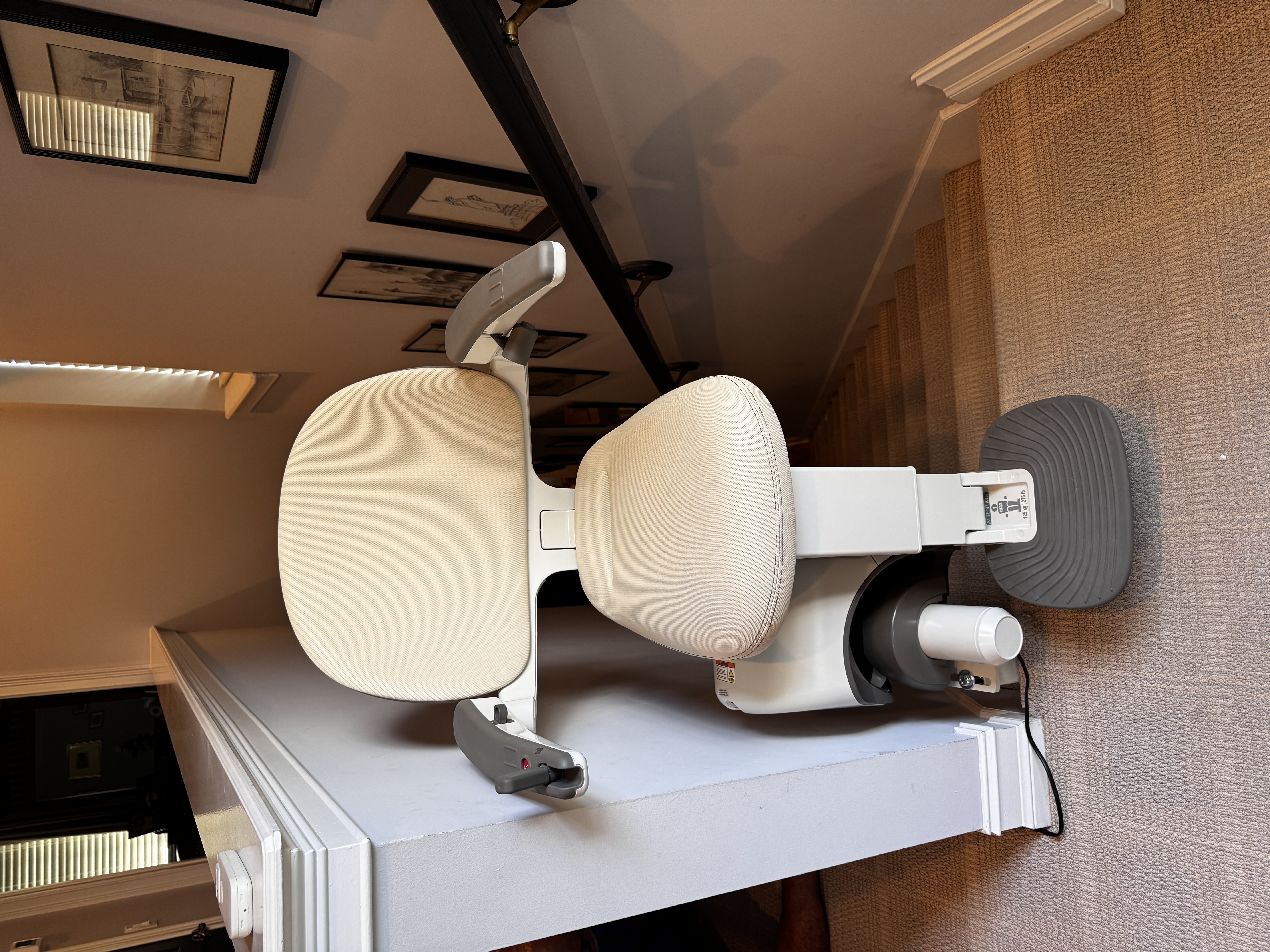
For a single flight, look at the full run from the lower floor to the upper landing. A professional measurement should account for the rail path, the starting and ending positions, nearby doors, and space to move around the chair. Even a staircase without a visible turn may need careful planning if the bottom opens into a narrow hallway or the top meets a doorway.
You should also consider who will use the stairs and how often. A lift that fits physically may still need a different stopping point or seat arrangement to make transfers easier. The goal is not simply to attach equipment to the steps; it is to create a usable route through the home.
Handling intermediate landings and changes in direction
An intermediate landing changes the decision because the user may need to transfer there if the staircase is served by more than one straight lift. Whether that is reasonable depends on the landing size, balance, strength, and ability to manage the transfer. A curved lift may provide a continuous route instead, depending on the layout and assessment.
Take note of every direction change, including a half-turn or a short second flight. Share those details during the consultation rather than describing the staircase only as “mostly straight.” Small changes can affect the rail design and the equipment that can be considered.
Evaluating narrow, spiral, or unusually shaped stairs
Narrow and spiral staircases need more than a quick visual comparison. The available width, the curve of the steps, the position of handrails, and the room needed for the user’s feet and body all influence whether a particular design is practical. Complex layouts do not automatically rule out a stairlift, but they do make an in-home assessment especially valuable.
Keep a short record of the details that may affect the evaluation:
- Where the staircase begins and ends
- Every landing, curve, and change in direction
- Doors, hallways, or furniture near the stairway
- Whether the user needs help with transfers
This information gives the installer a clearer starting point and helps your family discuss the real goal: safe, repeatable access between the areas you use.
Considering access to the top and bottom of the staircase
The landing areas can be just as important as the steps. At the bottom, you may need room to approach the seat without blocking a hallway or doorway. At the top, you may need a safe place to turn, stand, or move into the next room.
Ask where the lift will park when it is not in use and whether that position leaves enough room for other household members. A thoughtful assessment considers the whole transition, not only the ride itself.
Comparing cost, customization, and installation timelines
Cost comparisons are more useful when you separate the equipment from the work needed to fit it. Straight systems often have more standardized components, while curved systems require a rail designed for one staircase. Installation timing also depends on inventory, location, scheduling, staircase configuration, and whether additional preparation is needed.
Why straight stairlifts often use more standardized components
Straight stairlifts generally use a standardized rail that can be fitted to a straight staircase. That makes the planning process more predictable in many cases, although the final price still depends on the model, rail length, options, installation requirements, and location. A standard design does not mean every home receives the same quote.
If your staircase qualifies and the equipment is available, fast or next-day installation may be possible. NewDay Mobility notes that timing depends on the product, configuration, inventory, location, and scheduling, so you should treat a quick installation as an availability question rather than a guarantee.
Why curved stairlifts require a personalized design and quote
A curved stairlift requires a rail designed specifically for the individual staircase. Measurements, turns, landings, and stopping points all contribute to the design, and custom preparation generally means more time before installation. That is why a curved stairlift should be priced through a personalized quote rather than a fixed number copied from a different home.
For a broader look at the factors behind a Florida quote, you can read this stairlift cost guide. It is still wise to request a current assessment because two homes with similar-looking staircases may have different requirements.
Understanding factors that influence the final price
When you compare estimates, check that each one describes the same scope of work. A lower headline figure may not answer questions about the rail, options, installation, service, or removal later. Available equipment and installation conditions can also affect the final amount you are quoted.
The main items to clarify include:
| Cost consideration | Why it matters |
|---|---|
| Staircase layout | Turns, landings, and curves affect design complexity. |
| Rail length and design | The rail must match the route the lift will travel. |
| Lift model and options | Different equipment and selected options can change the quote. |
| Installation requirements | Home conditions and fitting work may affect preparation. |
| Location and availability | Scheduling, inventory, and service coverage can influence timing. |
Ask for the current total, what installation includes, and which terms apply to the specific equipment being offered. NewDay Mobility offers qualifying straight stairlift installations starting at $3,990. Actual pricing depends on the staircase, model, rail length, selected options, installation requirements, location, and equipment availability.
When fast or next-day installation may be possible
A straight stairlift may qualify for fast or next-day installation when the right product is available and the staircase is suitable. The assessment, equipment selection, inventory, location, and scheduling all have to align. Curved stairlifts generally require additional design and manufacturing time, so they should not be compared with a ready-to-install straight system on timing alone.
Before making arrangements, ask for a realistic timeline from assessment through installation. You can also ask what happens if the selected model is not currently available or if the staircase needs a different configuration.
Evaluating comfort, safety, and everyday usability
The best stairlift is one the user can operate with confidence every day. Comfort includes the seat and riding position, but it also includes getting on and off, using the controls, and sharing the staircase with others. A professional recommendation should reflect the person’s mobility, strength, balance, and routine rather than focusing only on the equipment category.
Choosing features based on the user’s mobility needs
Start with the user’s actual day. Can they approach the seat, sit down, remain stable during travel, and stand at the destination? Do they need assistance from another person? These questions can guide the discussion about controls, seating, and the way the lift is positioned at each end.
Daily usability matters most when a lift will be used several times a day. Ask the installer to explain the controls in plain language and let the intended user try the seating and transfer process whenever possible.
Considering transfers, seating, and staircase clearance
Transfers deserve particular attention at intermediate landings and at the top or bottom of the stairs. A seat may be comfortable during travel, but the approach and exit must also work with the available floor space. Measure nearby doors and walkways, and consider whether the chair or rail could affect normal movement when parked.
If the user needs a caregiver’s help, include that person in the assessment. A solution that looks suitable on paper may need a different parking position or layout to make assistance practical.
Planning for safe use by more than one household member
Many homes have one primary user but several people who still need the staircase. Discuss how the lift will be parked, whether it leaves room for others, and how children, visitors, or caregivers will move around it. Everyone should understand the basic operating instructions and the need to keep the stairway clear.
You should also consider future changes in the household. A layout that works today may need to remain useful if a caregiver helps more often or if the user’s mobility changes.
Confirming product details and warranty coverage before purchase
Before signing, ask for the exact product, included options, installation scope, service process, and warranty terms. Warranty coverage can vary by product, model, component, and current program, so a general statement may not describe the equipment in your quote.
NewDay Mobility offers a lifetime warranty on qualifying stairlifts, but you should confirm the specific coverage in writing. Also ask who provides service after installation and how repairs are handled if the equipment needs attention.
Florida-specific factors to consider
Florida homes vary widely, from single-story properties with exterior steps to multilevel houses with tight interior staircases. Humidity, heavy rain, salt air in some coastal areas, and sun exposure can affect how you think about an outdoor installation. Your local setting matters, but so do the details of the staircase and the way you enter and move through the home.
Deciding between indoor and outdoor stairlift applications
An indoor stairlift addresses movement between levels inside the house. An outdoor stairlift is intended for an exterior staircase, such as the route to a porch, entrance, garage, or another outdoor area. If both routes create barriers, they should be assessed separately because the environment and equipment requirements differ.
For exterior access, review the options described for outdoor stairlifts. The right choice depends on whether the stairs are straight or curved, how exposed they are, and how often the route is used.
Accounting for humidity, rain, and exterior staircase conditions
Outdoor equipment needs to be considered in the context of Florida’s weather. Look at drainage, roof coverage, direct sun, standing water, and the condition of the steps and handrails. A lift cannot correct loose, damaged, or poorly lit stairs, so those surrounding conditions should be part of the conversation.
Ask how the equipment is intended to be used and maintained in the location where it will be installed. Current product and service details should be confirmed for your specific property rather than assumed from a general description.
Considering multilevel homes, garages, and pool areas
Your most important route may not be the main staircase. You may need access to a second floor, a garage, a lower level, or a pool area. Map the destinations that matter most and decide whether the barrier is a single flight or part of a larger accessibility plan.
In some homes, a stairlift is appropriate for the stairs while a ramp or vertical platform lift makes more sense for a change in elevation elsewhere. Thinking about the whole property can prevent you from choosing equipment that solves only one small part of the problem.
Connecting your choice to local installation and service availability
NewDay Mobility serves homeowners throughout its Florida service area, including counties such as Orange, Seminole, Volusia, Brevard, Hillsborough, Palm Beach, Broward, and others. Availability can vary by location, product, installation requirements, and schedule, so homeowners outside the listed primary counties should confirm coverage directly.
Whether you live near Orlando, Melbourne, Tampa, Palm Beach, or another Florida community, ask who will install the equipment, what post-installation service is available, and how quickly help can be arranged if an issue occurs.
Choosing the right stairlift for your home
The right choice is the one that fits the staircase and supports the person who will use it. Start with the route, then compare equipment, installation, service, and payment details. Taking that order can keep the decision grounded and prevent a particular brand or feature from becoming more important than the home’s actual needs.
Matching the lift to the staircase before comparing brands
First identify whether the staircase is straight, curved, interrupted by landings, unusually narrow, or outdoors. Then consider the top and bottom access points, clearance, transfers, and the user’s mobility. Once those facts are clear, a professional can explain which type of stairlift is appropriate and which products may be available.
This approach is more reliable than choosing a model first and trying to make it fit afterward. It also gives you a fairer basis for comparing quotes from the same type of system.
Balancing budget, customization, and long-term needs
A straight lift may offer a more predictable starting point, while a curved lift may be necessary for a complicated layout. The least expensive initial option is not necessarily the most usable if it requires difficult transfers or leaves important rooms inaccessible. Consider how often the lift will be used and whether your needs may change.
Financing options may be available to qualified customers. Confirm the approval requirements, current lender terms, estimated monthly payments, and total financed cost before choosing an arrangement.
Understanding when a vertical platform lift or ramp may be more suitable
A stairlift is not the only way to improve access. A vertical platform lift may be more suitable when you need to move between levels with a mobility device, while a ramp may work better for a gradual change in elevation. Space, rise, property layout, and the user’s equipment all affect that decision.
NewDay Mobility provides vertical platform lifts and accessibility ramps in addition to stairlift solutions. Asking about alternatives does not commit you to one; it simply helps you compare solutions that address the full route through your home.
Preparing for an assessment with NewDay Mobility
Before an assessment, write down which rooms and exterior areas the user needs to reach, where assistance is needed, and any concerns about transfers or clearance. Take note of turns, landings, doors, and stairs outside the home. You can also bring questions about installation, service, rentals, buy-back options, and the equipment currently available.
A consultation with NewDay Mobility can help connect those details to a practical recommendation. The company’s guidance is based on the staircase, home, mobility needs, budget, and installation requirements rather than on a one-size-fits-all answer.
Confirming current pricing, financing, availability, and service terms
Get the current details in writing before you decide. Confirm the price for the exact lift, what installation includes, the expected timeline, warranty coverage, service arrangements, financing terms if applicable, and whether the equipment is currently available. These details can change and should not be inferred from an older article or a general starting price.
A careful comparison gives you more than a number. It shows whether the proposed lift will support safe, comfortable access in the places you actually use every day.
Conclusion
Choosing between a straight and curved stairlift becomes clearer when you begin with the staircase, then consider the user, the home, the Florida environment, and the practical terms of installation and service. A professional assessment can help you compare the right equipment and determine whether another mobility solution would better support your daily routine.
Frequently Asked Questions
What is the main difference between a straight and curved stairlift?
A straight stairlift is generally designed for one uninterrupted flight, while a curved stairlift is designed for turns, landings, curves, or more complex staircase layouts.
Is a curved stairlift always better than a straight stairlift?
No. The suitable option depends on the staircase layout, the user’s mobility, transfer ability, available space, and how the lift needs to fit into the home.
Can a straight stairlift be used on stairs with a landing?
A straight lift is generally intended for a continuous straight run. A staircase with an intermediate landing may require more than one lift or a custom curved design, depending on the layout and the user’s ability to transfer safely.
Are outdoor stairlifts suitable for Florida homes?
Outdoor stairlifts may be suitable for exterior stairs leading to areas such as entrances, porches, or garages. The staircase, exposure to weather, drainage, and equipment requirements should be assessed before purchase.
How long does stairlift installation take?
Timing varies by equipment, staircase configuration, inventory, location, preparation, and scheduling. Straight systems may qualify for faster installation in some situations, while custom curved systems generally require additional design and preparation.
What should you ask for in a stairlift quote?
Ask for the exact equipment, rail design or length, options, installation scope, service arrangements, warranty coverage, expected timeline, current price, and any financing terms that apply to your situation.
Could a ramp or vertical platform lift be a better choice?
Possibly. A ramp or vertical platform lift may be more suitable when you need to move with a wheelchair or scooter, when the main barrier is an exterior rise, or when the property layout makes a stairlift less practical.