
Key Takeaways
A narrow staircase does not automatically rule out a stairlift. The right choice depends on the staircase layout, landing space, obstructions, and the rider’s needs.
-
Straight stairlifts are often suitable for uninterrupted staircases.
-
Curved stairlifts can be designed for turns, landings, and complex layouts.
-
Fold-up components may preserve more usable stairway space.
-
An in-home assessment is more dependable than measurements alone.
-
Florida homeowners should confirm pricing, availability, installation timing, and service before choosing equipment.
Understanding what makes a staircase “narrow”
A staircase can feel narrow because of its tread width, nearby walls, a handrail, or limited space at either landing. The usable path matters more than a single measurement taken across the steps. You also need to consider how the lift will be parked and whether other household members can still use the stairs. For that reason, a stairlift for narrow stairs should be selected after reviewing the entire route, not just the width of one step.
Typical stairway dimensions and why they matter
Staircases vary considerably between Florida homes, including older houses, townhomes, condominiums, and newer construction. An installer will generally review tread depth, stair width, riser height, the stair angle, and the shape of the landings. These details help determine whether a standard rail is practical or whether the equipment needs a different configuration. A measurement that looks comfortable on paper may feel very different once a seat, footrest, and rider are on the stairs.
How the available walking width affects stairlift selection
The remaining walking space is a household consideration as much as an equipment consideration. A lift may fit on the staircase while still leaving too little room for someone to pass comfortably, carry laundry, or use the stairs in an emergency. Fold-up parts can help, but the final clearance depends on the model and installation position. Your installer should explain how much space remains both when the lift is parked and when it is moving.
Clearance at the top and bottom landings
Landings need enough room for a safe approach, transfer, and exit. At the bottom, a door, hallway, or turn toward another room may affect where the rail can end. At the top, you may need room to turn away from the stairs without stepping backward. A compact rail arrangement can help in some homes, but the best solution depends on the landing’s actual shape and surrounding traffic.
Obstacles such as doors, walls, and handrails
Doors, trim, radiators, windowsills, and banisters can all influence the installation. A door that opens toward the stairs may require a different parking position, while a wall-mounted handrail may need to be considered alongside the rail. Do not remove or relocate household features before an assessment; an installer can explain what is necessary and what can remain in place.
How stairlifts can work in limited spaces
Limited space does not always mean you need to remodel your home. Straight, curved, and outdoor stairlift solutions are available for different staircase layouts, while vertical platform lifts may suit some entrances or changes in floor level. The goal is to fit the equipment to the home without making everyday movement harder for everyone else. A professional professional in-home assessment can help determine which option best fits the staircase and the user’s needs.
Compact straight stairlifts for uninterrupted staircases
A straight stairlift is generally intended for a staircase that runs in one continuous direction without a turn or intermediate landing. It usually uses a standardized rail fitted to the straight staircase, although the final arrangement still depends on the home and installation conditions. Narrow stairs may require careful consideration of the seat position, rail placement, and landing ends. Ask how the lift will park so the bottom of the stairs does not become a daily obstruction.
Custom curved stairlifts for turns and intermediate landings
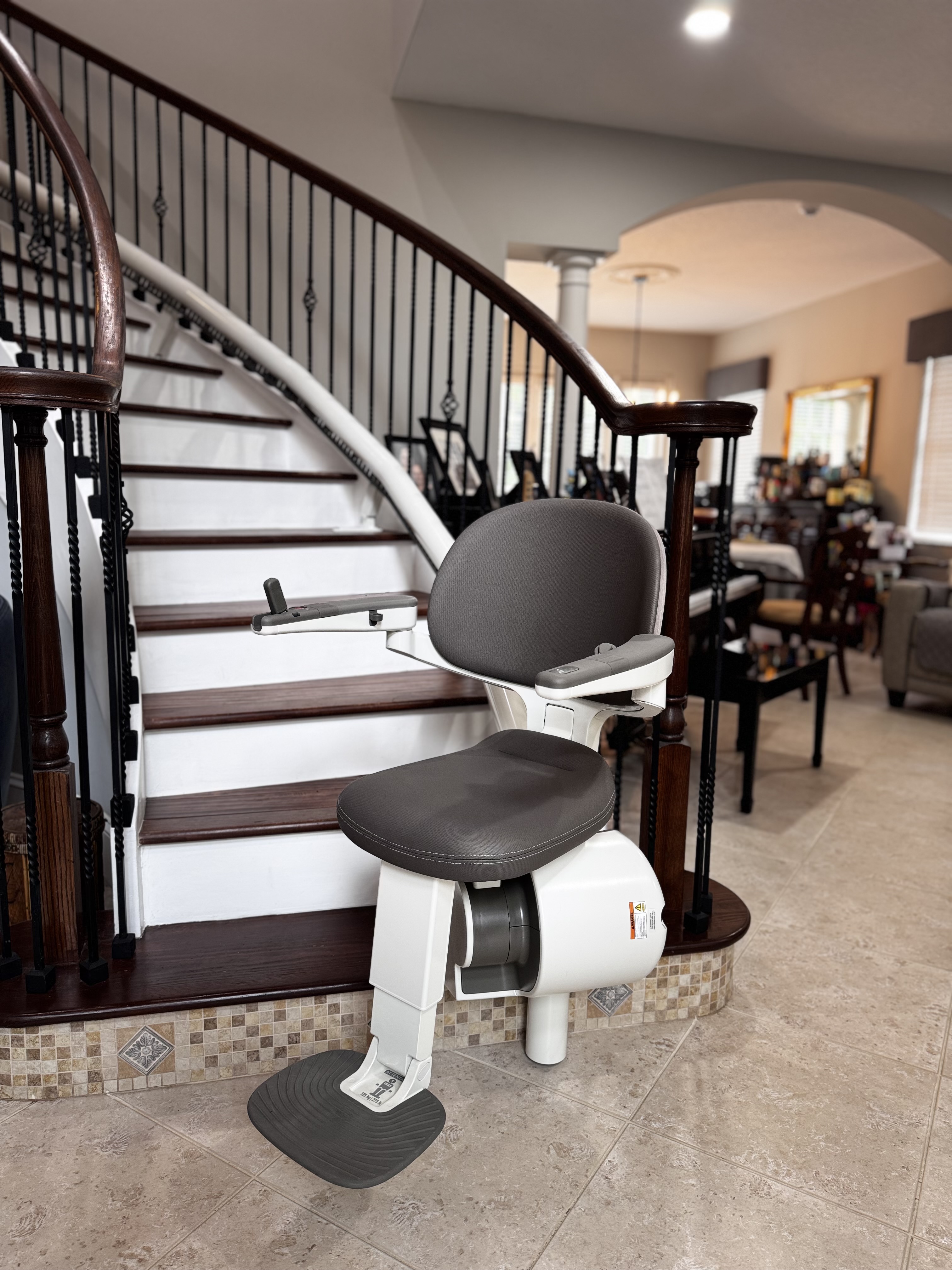
Curved stairlifts are individually designed for staircases with turns, curves, intermediate landings, or more complex layouts. The rail is designed for the individual staircase rather than selected as a standard straight section. NewDay Mobility describes custom curved stairlifts as solutions for curved, narrow, spiral, and complex staircase configurations when appropriate. Because design and manufacturing are typically involved, you should expect the consultation and scheduling process to differ from that of a standard straight lift.
Fold-up seats, arms, and footrests for improved clearance
Seats, armrests, and footrests that fold can reduce the amount of space occupied when the lift is not being used. That can be helpful if family members still need to walk on the stairs. Folding parts do not eliminate the need for an assessment, however, because the rail, wall, banister, and landing may still limit clearance. Have the installer demonstrate the folded position and explain whether you can operate it comfortably.
When a vertical platform lift may be a better alternative
A vertical platform lift can be worth discussing when the main challenge is a change between levels rather than a conventional staircase. It may also be relevant where a staircase is exceptionally difficult to navigate with a seated lift, or where an exterior route is more practical. The right choice depends on available floor space, access points, and local installation conditions. Treat it as an alternative to evaluate, not an automatic replacement for a stairlift.
Measuring a narrow staircase before choosing a stairlift
Good planning starts with more than measuring from wall to wall. The installer needs to understand how you approach the stairs, where you transfer, and what happens at both ends of the route. Photos can help with an initial conversation, but they cannot always show the full effect of trim, door swings, or a sloping ceiling. A professional stairlift installation assessment can connect the measurements to your daily routine and the home’s practical limitations.
Measurements an installer needs to review
Expect the assessment to cover the usable stair width, tread and riser dimensions, stair angle, rail length, and the space available at the top and bottom. The installer may also review nearby doorways, ceiling height, and the position of power access where relevant. These measurements help identify whether a straight system is plausible or whether a custom rail should be considered. They also support a more accurate discussion of installation requirements and pricing.
Checking stair angle, landing space, and doorway clearance
The stair angle affects how the lift travels, while the landings determine how you get on and off safely. Doorway clearance matters because the lift should not block a frequently used entrance or create a difficult turn for the rider. Measure the route beyond the first step as well as the staircase itself. A few extra feet in a hallway can change the most practical parking position.
Identifying banisters, radiators, trim, and other obstructions
Obstructions are easy to overlook during a quick measurement. A radiator may project into the lower stair area, a banister may reduce the usable width, and thick trim can affect where the rail sits. Note anything attached to the wall or close to the steps, including storage, light switches, and doors. The installer can then determine which items matter and whether any adjustment is needed.
Why an in-home assessment is more reliable than measurements alone
An in-home assessment lets the installer observe the complete route and discuss how you will use it. You can show where you normally sit, transfer, or place a walker, and a family member can raise concerns about shared stair access. It also gives you a chance to see how different configurations may affect the hallway. The lived-in route matters just as much as the dimensions on a tape measure.
Choosing the right stairlift for a Florida home
Florida homes face a mix of indoor, exterior, straight, curved, and multi-level access challenges. Humidity, rain, salt air near the coast, and exposure to heat can matter when equipment is installed outdoors. Indoors, the rider’s comfort and transfer ability may be the deciding factors. NewDay Mobility’s guidance is based on the staircase, home, mobility needs, budget, and installation requirements rather than on a single model for every household.
Matching the lift to a straight, curved, or complex staircase
Start by classifying the route, but do not stop there. A straight staircase may suit a standardized rail, while a staircase with a turn, curve, intermediate landing, or unusual shape generally calls for a custom curved approach. A spiral or tightly arranged staircase needs especially careful review. The installer should explain why a proposed configuration fits the route and what compromises, if any, it creates at the landings.
Comparing indoor and outdoor stairlift requirements
An indoor lift is protected from direct weather, while an outdoor lift must be appropriate for exterior stairs and the conditions around your home. Consider whether the route leads to a porch, garage, side entrance, or pool area, and how rainwater will affect the surrounding space. Outdoor equipment also needs a practical parking location and a plan for routine care. NewDay Mobility offers outdoor stairlifts designed for exterior staircases, with the final selection depending on the site and equipment requirements.
Considering the rider’s comfort, mobility, and transfer needs
Think about how you will approach the seat, sit down, ride, and stand up at the other end. A person who has difficulty bending may need a different seat or transfer arrangement from someone whose main concern is balance on the stairs. Consider control placement, arm support, foot position, and whether a caregiver will assist. A short demonstration during the consultation can reveal concerns that are difficult to describe in advance.
Reviewing available equipment from manufacturers such as Access BDD and Harmar
NewDay Mobility works with products from manufacturers including Access BDD and Harmar, depending on the staircase, needs, availability, and installation requirements. Access BDD includes the Flow X curved stairlift, while Harmar equipment includes Pinnacle straight stairlifts, curved and outdoor stairlift options, and vertical platform lifts. These names are starting points for a conversation, not a promise that every model will be available or suitable for your home. Ask for current specifications and availability before making a decision.
Installation, safety, and everyday use
A well-planned installation should make the stairs easier to use without turning them into a new obstacle. The installer needs to secure the equipment, test its operation, and explain the controls in language you can remember. Your household should also agree on where the lift will be parked when it is not in use. Small habits, such as keeping the steps clear, can make a meaningful difference.
How professional installation protects stairway access
Professional installation accounts for the rail position, landing approach, surrounding walls, and the structure of the staircase. It also includes testing the completed system and explaining basic operation to the user. Avoid treating a narrow staircase as a do-it-yourself measurement project; a small error at the bottom or top can affect daily access. Installation should leave you confident about boarding, riding, exiting, and sharing the stairs with others.
Safety features and user habits to discuss with an installer
Ask the installer to explain the available safety features for the model under consideration, along with any operating limits. You should understand how to use the controls, what to do if an obstruction is detected, and how the lift is charged or parked. Keep loose clothing, bags, and household items away from the moving path. If your mobility changes, arrange another conversation rather than adapting the equipment yourself.
Keeping part of the staircase usable for other household members
A stairlift should support the whole household where possible. Fold the seat, arms, and footrest when appropriate, park the lift in the position recommended by the installer, and keep the remaining walking path free of clutter. Family members should know how to pass safely and when to wait. If the staircase is particularly tight, discuss household routines during the assessment instead of discovering conflicts after installation.
Service and repair considerations after installation
Ask who to contact if the lift stops working, makes an unusual sound, or needs an adjustment. Continued service and repair can help you maintain reliable everyday access, but the exact support available depends on the equipment and service arrangement. Keep the model information and installation paperwork in an easy-to-find place. NewDay Mobility provides service and repair, and you should confirm the details that apply to the lift you choose.
Budgeting for a stairlift for narrow stairs
The cost of a stairlift depends on the staircase and the equipment, not simply on the word “narrow.” Straight systems may be more predictable when the stairs are uninterrupted, while curved systems require individual design.Installation conditions, rail length, selected options, location, and equipment availability can all affect the final quote.For broader planning, review this Florida stairlift cost guide, then request pricing based on your own home.
Why narrow or complex staircases may require a custom quote
A narrow staircase may require careful positioning, a special rail end, or a curved configuration. If the staircase turns or includes intermediate landings, the rail must be designed for that specific route. Even a straight staircase can need a custom review when doors, radiators, or limited landings are involved. A written quote should make clear what equipment, installation work, and current options are included.
General factors that influence stairlift pricing
The main factors usually include the staircase type, rail length, model, options, installation requirements, and location. Outdoor installations may involve additional site considerations, while curved systems require individualized design. Your rider’s needs can also influence the equipment selected. Avoid comparing two prices until you know whether they cover the same type of lift and installation service.
Straight stairlift pricing considerations
NewDay Mobility offers qualifying straight stairlift installations starting at $3,990. Actual pricing depends on the staircase, model, rail length, selected options, installation requirements, location, and equipment availability. Curved stairlifts require a personalized quote because the rail is designed for the individual staircase. Request the complete installed price in writing before making a decision.
Financing, warranty coverage, and questions to confirm
Financing options may be available to qualified customers. NewDay Mobility offers a lifetime warranty on qualifying stairlifts, but coverage can vary by product, model, component, and current program. Ask for the exact warranty coverage, service terms, financing conditions, approval requirements, estimated monthly payment, and total financed cost in writing. If you are exploring assistance programs, confirm their rules separately rather than assuming a stairlift is covered.
The consultation and installation process in Florida
The consultation should give you a clear picture of what can fit, what it may cost, and how the installation will affect daily life. You can expect the conversation to cover the staircase, rider, household, equipment, schedule, and after-installation support. Availability can differ between counties and between standard and custom equipment. NewDay Mobility serves homeowners throughout its Florida service area, with current availability confirmed during the consultation.
What to expect during a staircase evaluation
An installer will review the stairs, landings, doorways, obstacles, and access route around the home. You should also describe the rider’s mobility, transfer routine, and any concern about other people using the stairs. This is the right time to ask for a demonstration, discuss indoor or outdoor use, and clarify the proposed parking positions. Bring a family member or caregiver if they will help with daily operation.
How product availability and configuration affect scheduling
A straight stairlift may be available sooner when the appropriate equipment is in inventory and the staircase is ready for installation. A custom curved stairlift generally requires additional design and manufacturing time. Location, configuration, installer scheduling, and site conditions can also affect the timeline. Ask for an estimate based on your actual staircase rather than a generic promise.
When fast or next-day installation may be possible
Fast or next-day installation may be possible for some straight stairlifts when the product, staircase configuration, inventory, location, and schedule all allow it. It should not be assumed for every home or every model. Custom curved systems generally need more time because the rail is designed for the individual staircase. For a fuller explanation of timing, review this installation timeline guide and confirm the current estimate during your assessment.
Confirming service availability in NewDay Mobility’s Florida service area
NewDay Mobility serves homeowners across Florida, including Orange, Seminole, Volusia, Brevard, Hillsborough, Miami-Dade, Palm Beach, Broward, and many other Florida counties. Product and service availability can vary by location, staircase configuration, installation requirements, and scheduling, so confirm current availability directly during your consultation.
Conclusion
A narrow staircase may still accommodate a stairlift, but the answer depends on the full route, the available clearance, and the rider’s everyday needs. An in-home assessment can help you compare a straight, curved, outdoor, or vertical platform solution and understand the likely cost and timing. When you are ready to discuss your staircase with NewDay Mobility, request an assessment for guidance based on your Florida home.
Frequently Asked Questions
Can a stairlift fit on very narrow stairs?
Often, a stairlift can fit on a narrow staircase, but suitability depends on the stair width, rail position, landing space, obstacles, and the model selected. An in-home assessment is the most reliable way to confirm the available clearance.
Will other people still be able to use the stairs?
They may be able to use the stairs if enough walking space remains and the lift is folded or parked appropriately. The installer should explain the remaining clearance and help your household establish safe routines.
Is a straight stairlift less expensive than a curved stairlift?
Straight stairlifts are often simpler to quote when the staircase is uninterrupted. Curved stairlifts are individually designed, so they require a personalized quote based on the staircase and installation requirements.
Do narrow stairs always need a curved stairlift?
No. Narrowness alone does not determine whether a lift is straight or curved. A straight lift may work if the staircase runs continuously, while turns, landings, or complex layouts generally call for a curved configuration.
Can a stairlift be installed outdoors in Florida?
Outdoor stairlifts are available for suitable exterior staircases, but the equipment and installation must be assessed for the route, weather exposure, landing conditions, and the way you will use the entrance.
How long does stairlift installation take?
Timing varies by equipment, staircase configuration, availability, site conditions, and scheduling. Straight systems may be installed more quickly when conditions allow, while custom curved systems generally require additional design and manufacturing time.
What should you ask before accepting a stairlift quote?
Ask what equipment and installation work are included, how the lift will park, what warranty applies, how service is handled, which financing terms apply, and whether the quote reflects your specific staircase and total installed cost.