
Key Takeaways
A stairlift’s weight capacity is only one part of choosing a safe, comfortable solution for your home. The staircase, seating needs, installation conditions, and the user’s total carried weight all matter.
- Check the exact rated capacity of the model being considered.
- Include clothing and any small personal items permitted by the manufacturer in the total load.
- Match the lift to the staircase, whether it is straight, curved, or outdoors.
- Ask for a professional assessment before ordering equipment.
- Compare the quote, warranty, financing terms, and long-term service support.
Understanding stairlift weight capacity
If you are asking how much weight can a stairlift hold, the most accurate answer is that capacity varies by model and installation. A stairlift is not selected by a single industry-wide number. You need to look at the equipment’s current specifications alongside the user’s mobility, seating, and staircase requirements.
What stairlift weight capacity means
Weight capacity is the maximum total load the stairlift is designed to carry during normal operation. That generally means the rider, clothing, and any small personal items permitted by the manufacturer. The rating should come from the manufacturer’s current documentation and be confirmed before purchase.
A capacity rating is not a suggestion for testing the equipment beyond its limit. If the user’s weight is close to the stated capacity, allow the installer to review the situation carefully instead of relying on an estimate or an old product description.
Why capacity varies by model and manufacturer
Manufacturers design different stairlifts for different users, staircases, and operating conditions. Rail configuration, drive components, seat design, and the intended setting can all affect the rated capacity. Availability and specifications may also change, so online figures should not replace a current quote.
NewDay Mobility works with equipment from established manufacturers, including Access BDD and Harmar, depending on the staircase, user requirements, availability, and installation conditions. For a broader overview of model selection and staircase planning, review these stairlift guides for Florida homeowners before speaking with an installer.
The difference between standard and heavy-duty stairlifts
A standard stairlift may suit many everyday users, while a heavy-duty option is designed for a higher-capacity requirement. Heavy-duty equipment can also involve different seating, armrest, or space considerations. The right choice depends on the complete situation, not simply on selecting the largest-looking lift.
You should ask which current models meet the required capacity, whether the stair width is suitable, and how the seat supports a safe transfer. Do not assume that a heavy-duty lift will fit every narrow or curved staircase without an assessment.
Why the user’s total carried weight matters
The rider’s weight is the starting point, but clothing and permitted personal items also contribute to the total load. Do not carry loose or bulky mobility equipment unless the stairlift manufacturer provides an approved attachment or method. Allow a reasonable capacity margin rather than choosing a model whose limit closely matches the expected load.
Be candid during the assessment. If the user sometimes carries an item upstairs, uses a portable oxygen container, or needs a particular transfer position, mention it before equipment is selected. That information helps the installer recommend a practical solution rather than one that only works under ideal conditions.
Factors that affect how much weight a stairlift can hold
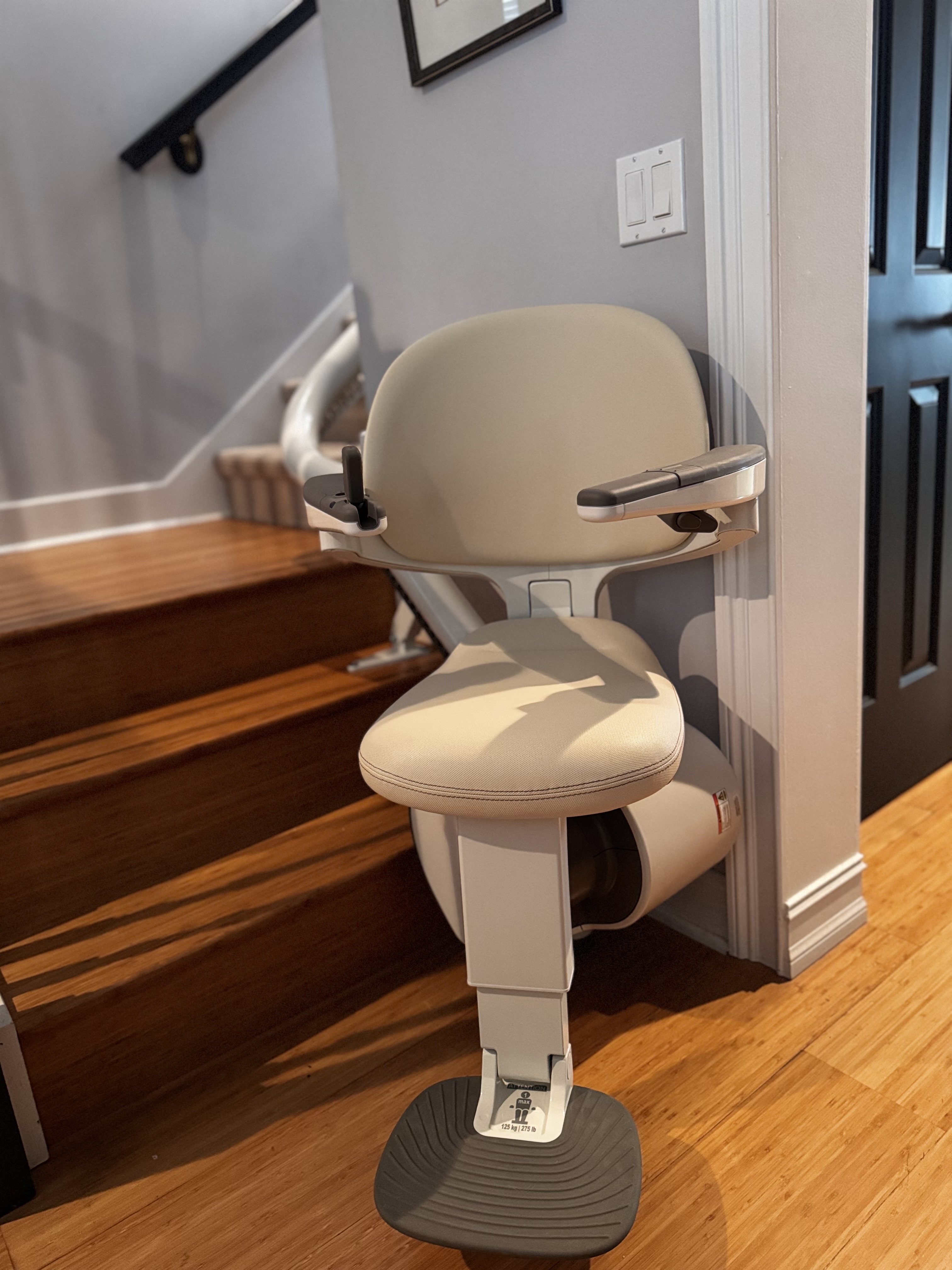
The capacity question cannot be separated from the staircase itself. A lift must be appropriate for the rail path, available clearance, landing space, and environment. An in-home review is especially helpful when the user needs a wider seat, extra support, or a higher-capacity model.
Staircase shape and rail configuration
A straight staircase often allows a standardized rail to be fitted along one uninterrupted flight. A staircase with turns, curves, intermediate landings, or unusual geometry generally requires a rail designed for that specific layout. The shape can affect which models are available and how the equipment is positioned.
Narrow stairs deserve particular attention because a higher-capacity seat may need more usable width. The installer should check walking clearance, doorways, landings, and any obstruction that could affect safe entry or exit.
Indoor versus outdoor installation
Outdoor stairs introduce exposure to Florida heat, humidity, rain, and, in some areas, salt air or storms. The equipment must be suitable for the exterior location, and the installation plan should account for drainage, shelter, power, and routine care. A lift intended for indoor use should not automatically be treated as appropriate outdoors.
NewDay Mobility provides straight, curved, and outdoor stairlift solutions, with equipment selection based on the home and the user’s needs. For exterior planning, this outdoor stairlift guide offers a useful checklist of climate and layout questions to raise during an assessment.
Seat size, armrests, and comfort requirements
Capacity and comfort often overlap. A user may need more room to sit securely, longer or differently positioned armrests, or a transfer-friendly seat. Those choices can affect the usable staircase width and the space required at the top and bottom.
Ask the installer to consider how the user will sit down, fasten the belt if one is included with the selected model, and stand up at the landing. A technically adequate capacity is not enough if the seating position makes daily use difficult.
Installation conditions and equipment selection
The condition of the stairs, attachment points, electrical access, and landing space can influence the installation plan. Professional installers measure the staircase and check the home rather than relying only on photographs or a general estimate. They can then explain whether the requested capacity and seating arrangement are realistic for that setting.
The following details are worth having ready for your consultation:
- The user’s current weight and any likely change in daily carried load.
- The staircase type, width, turns, landings, and nearby doors.
- Whether the lift will be installed indoors or on exterior stairs.
- The user’s transfer, seating, and mobility-aid requirements.
Sharing these details early helps narrow the equipment choices and reduces the chance of a costly change after ordering. It also gives you a clearer explanation of why one model may be suitable while another is not.
Choosing between straight, curved, and outdoor stairlifts
The three broad categories solve different access problems. A straight lift is generally suited to one straight flight, a curved lift is designed around a more complex staircase, and an outdoor lift is made for exterior conditions. Capacity still matters in each category, but the layout determines which equipment can safely be installed.
Weight considerations for straight staircases
Straight stairlifts generally use a standardized rail that can be fitted to a straight staircase. That can simplify equipment selection, but it does not mean every straight model has the same capacity or seat dimensions. You still need the current specification for the specific model and a check of the stair width.
Straight stairlifts may also offer more than one seating configuration. Your installer should compare the rider’s weight, transfer needs, daily use, and clearance before recommending a particular option.
Capacity planning for curved staircases
Curved stairlifts require a rail designed specifically for the individual staircase. Turns, corners, and intermediate landings influence the rail design, seat orientation, parking position, and available clearance. A higher-capacity request must therefore be reviewed together with the staircase measurements.
Custom design can also affect the quote and timeline. NewDay Mobility describes curved stairlifts as individually designed solutions for staircases with turns, curves, intermediate landings, or more complex layouts, so a personalized assessment is essential rather than optional.
What to consider for outdoor stairs
For outdoor stairs, consider both the user’s weight and the conditions the equipment will face. Rain, heat, humidity, wind, and coastal air can affect installation planning and ongoing maintenance. You should also think about where the user will safely transfer at each end of the lift.
An outdoor staircase may be straight or curved, and the route may lead to a porch, entrance, garage, or another level. The outdoor stairlift options should be discussed alongside shelter, drainage, electrical access, and the user’s normal routine.
When a vertical platform lift may be more appropriate
A stairlift carries a seated person along the stairs, while a vertical platform lift moves a person and, depending on the equipment, a mobility device between levels. If the user cannot safely transfer into a stairlift seat or needs to remain in a wheelchair, a vertical platform lift may deserve consideration.
Space, entry points, platform dimensions, and local installation conditions still need review. The best solution is the one that supports the user’s actual routine, not simply the one that fits the original search term.
How to choose the right stairlift for the user
Choosing equipment starts with the person who will use it every day. You need to consider body weight, balance, transfers, comfort, vision, reach, and confidence with the controls. A family member or caregiver can add useful observations, especially when the user has difficulty describing what feels unsafe.
Start with an accurate weight and mobility assessment
Use a recent, accurate weight rather than a guess from several months ago. Then discuss how the user walks, sits, stands, turns, and manages the stairs now. These details help determine whether a standard, higher-capacity, or different mobility solution should be considered.
A professional assessment also looks at the staircase and the user together. For example, a model with an adequate rating may still be unsuitable if the user cannot transfer safely at the landing or if the seat position creates unnecessary strain.
Account for clothing and permitted personal items
Think about a normal day, not an unusually light trip. A jacket, purse, or small permitted item contributes to the total load and may affect how the user sits. Never balance loose or bulky equipment on the rider’s lap; ask the installer about approved ways to move mobility aids between floors.
Write down the items the user regularly brings between floors. That simple list gives the installer a more realistic picture of the required capacity and helps prevent surprises after installation.
Match the lift to transfer and seating needs
The user should be able to approach the seat, turn, sit, and leave it with as little difficulty as possible. Seat height, armrest position, swivel or transfer features when available, footrest space, and belt access can all affect confidence. Comfort is not a luxury if the lift will be used several times a day.
Ask to see how the user would enter and exit the lift during the assessment. A caregiver should also understand where to stand and how to provide help without blocking the stairway or pulling the rider off balance.
Confirm current specifications before ordering
Product pages and older brochures can become outdated. Before you sign an order, ask for the current rated capacity, seat dimensions, rail configuration, installation requirements, warranty terms, and expected availability for the selected model. Get any important assumptions written into the quote.
A useful Florida stairlift cost guide can help you understand why a personalized quote may differ from a simple starting figure. The final price depends on the staircase, model, rail length, options, location, installation requirements, and current promotions.
Safety considerations for higher-capacity needs
Staying within the equipment’s rating protects the user, the lift, and the home. A person who needs a higher-capacity model may also benefit from additional attention to seat dimensions, transfer space, and staircase clearance. Careful planning supports both the rider and anyone assisting them.
Why staying within the rated capacity matters
A stairlift is engineered for a stated maximum load. Exceeding that rating can affect operation and may create an unsafe situation, even if the lift appears to move normally. Never use a higher-capacity model as a reason to carry extra people or unsecured items.
If the user’s weight changes substantially, ask whether the current equipment remains appropriate. A service professional can review the lift rather than leaving the family to make a guess.
How professional installation supports safe operation
Installation involves more than attaching a rail. The installer must account for the staircase, attachment points, clearances, charging location, and safe operation at the landings. The lift should be tested after installation, and the user should receive an explanation of normal use.
Professional installation also gives you a point of contact if the home conditions or the user’s needs change. NewDay Mobility provides professional installation and continued service after installation, with timing dependent on the product, staircase, inventory, location, and scheduling.
The importance of correct positioning and secure transfers
The rider should sit fully back in the seat, keep feet and hands positioned as instructed, and use the provided safety equipment as directed. Bags, blankets, and clothing should not interfere with the controls, rail, or footrest. Transfers should happen on a clear, stable landing whenever possible.
If a caregiver helps, agree on a consistent routine. Rushing at the top or bottom of the stairs can create more risk than the ride itself, particularly when the user is tired or unsteady.
When a stairlift should be inspected or serviced
Have the lift checked if it makes an unusual sound, stops unexpectedly, moves unevenly, fails to charge, or shows another change in operation. Regular service can also be appropriate based on usage, equipment type, and the Florida environment. Do not attempt electrical or mechanical repairs yourself.
For practical guidance on maintenance timing and warning signs, review this stairlift service guidance. Prompt attention is better than continuing to use equipment that no longer feels reliable.
What Florida homeowners should consider before buying
Florida homes vary widely, from compact townhomes and older houses to larger two-story properties and coastal residences. Your staircase may be indoors, attached to a garage, or exposed to weather. Local conditions make an in-home assessment more useful than choosing from a generic capacity chart.
Staircase layouts commonly found in Florida homes
You may have a single straight flight, a staircase with a landing and turn, a winding interior route, or exterior steps leading to an elevated entrance. Narrow stairs and limited landing space can affect the seat, rail, parking position, and available walking clearance.
Measure cautiously, but do not rely on a do-it-yourself measurement as the final decision. A professional can identify obstructions and determine whether the intended lift will leave enough room for other household members to use the stairs.
Indoor and exterior conditions that affect installation
Humidity, heat, rain, salt air, and storm exposure are relevant when equipment is installed outside or near an open entry. Older homes may also have unusual stair construction or limited electrical access. These conditions do not automatically rule out a stairlift, but they should be part of the equipment and installation discussion.
For indoor installations, consider air-conditioning patterns, storage near the stairs, pets, and doors that open into the landing. Small details can affect daily convenience and safe clearance.
Service area, scheduling, and installation requirements
Before ordering, confirm that the provider serves your Florida location and can support the selected equipment after installation. NewDay Mobility serves homeowners throughout its Florida service area, including counties such as Orange, Volusia, Brevard, Broward, Palm Beach, Hillsborough, and Seminole, with availability depending on location, product, installation requirements, and scheduling.
Straight stairlifts may qualify for fast or next-day installation when conditions allow, while custom curved systems generally require additional design and manufacturing time. Ask for a realistic timeline rather than assuming every installation can be completed immediately.
How local site assessments help identify the right solution
A site assessment brings the equipment discussion back to your actual home. The installer can review the staircase, landings, power, weather exposure, transfer areas, and the user’s routine in one visit. You should leave with a clear explanation of the recommended solution and any alternatives.
It is also the right time to ask how the lift will be attached, what minor marks may remain if it is removed, and how future repairs are handled. Clear answers make the purchase easier for the whole family.
Comparing cost, warranty, and long-term support
The lowest initial figure is not always the lowest long-term cost. Capacity, seat options, rail design, installation conditions, service access, and warranty coverage can all affect the quote. Compare the complete proposal rather than looking only at the equipment line.
Why capacity can affect the overall quote
A higher-capacity lift may require a different model, seat arrangement, rail configuration, or installation approach. Curved staircases are individually designed, so their quotes are personalized rather than based on a fixed standard price. Outdoor equipment may also involve additional planning for weather exposure and electrical access.
NewDay Mobility may offer straight stairlifts starting at $3,990 installed, when applicable, but actual pricing depends on the staircase, model, rail length, options, installation requirements, location, and current promotions. Request a current personalized quote before making a comparison.
What to ask about warranty coverage
Ask whether the warranty applies to the exact model and which components, labor, and service situations are included. Coverage may vary by product, model, component, and current program. You should also ask what could void coverage and whom to contact if a problem occurs.
Qualifying stairlifts may be covered by a lifetime warranty through NewDay Mobility, but you should confirm the exact terms for the equipment in your quote. A written explanation is more useful than a broad promise made during an early conversation.
Financing options for qualified customers
Financing can make a mobility project easier to plan, but approval and terms are not the same for every customer. Ask about the current program, promotional period, total obligations, and what happens if you do not qualify. Keep the financing discussion separate from the lift’s safety and suitability.
NewDay Mobility offers financing options for qualified customers, subject to approval and applicable terms. Ask about current plans, payment amounts, total cost, and any promotional conditions before making a decision.
The value of professional service and repair support
Ask how service requests are scheduled, which repairs may be covered, and how replacement parts are handled. These questions are especially relevant for a lift used several times a day.
Compare providers on installation quality, product choice, warranty clarity, financing, and ongoing support. The right decision gives you a workable lift today and a clear path for help later.
Get a Personal Assessment
If you are comparing stairlift options in Florida, contact NewDay Mobility for a conversation about your staircase, the user’s needs, and current equipment availability. You can also schedule an assessment to begin with a practical review instead of a guess based on weight alone.
Conclusion
A stairlift’s rated capacity must match the user’s total everyday load, but the safest choice also fits the staircase, seating needs, transfer routine, and Florida installation conditions. By requesting current specifications and a professional assessment, you can compare straight, curved, outdoor, or vertical platform solutions with greater confidence.
Frequently Asked Questions
How much weight can a stairlift hold?
There is no single capacity that applies to every stairlift. The maximum depends on the specific model and manufacturer, so confirm the current rated capacity and include the rider’s clothing and any small personal items permitted by the manufacturer.
Does a person’s weight include items carried on the stairlift?
Yes. The total load includes the rider, clothing, and any small personal items permitted by the manufacturer. Do not carry loose, bulky equipment or mobility aids unless the manufacturer provides an approved method or attachment.
Are heavy-duty stairlifts available for people who need greater capacity?
Heavy-duty stairlifts are designed for higher-capacity requirements, but the correct model must also fit the staircase and support safe transfers. An assessment is needed to confirm capacity, seating, clearance, and installation suitability.
Does a curved staircase change the weight capacity question?
It can. A curved stairlift uses a rail designed for the individual staircase, and turns, landings, and available clearance affect equipment selection. The capacity must be reviewed together with the custom rail design and seat requirements.
Can a stairlift be installed on outdoor stairs?
Outdoor stairlifts are designed for exterior staircases, but the equipment and installation must suit conditions such as rain, humidity, heat, and salt air. The location, shelter, drainage, power, and transfer areas should be assessed.
What if the user needs to remain in a wheelchair?
A vertical platform lift may be more appropriate when the user cannot safely transfer into a stairlift seat or needs to travel with a wheelchair. Space, platform requirements, entry points, and the home’s layout all need professional review.
What should you ask before ordering a stairlift?
Ask for the exact rated capacity, seat dimensions, installation requirements, warranty terms, service process, current price, financing terms, and expected timeline. Also confirm that the provider serves your location and can support the equipment after installation.