
Key Takeaways
A stairlift will often remain usable during a power outage, but its backup battery is not unlimited. Your safest approach is to understand the equipment, keep it charged, and have another plan for moving between floors during a Florida storm.
- “Most modern stairlifts operate on rechargeable batteries, while household electricity keeps them charged.
- The number of available trips depends on the model, battery condition, staircase, and usage.
- Keep the lift connected to its charging point and investigate warning lights before an outage.
- Do not use the stairlift during flooding, exposed electrical hazards, or unsafe stairway conditions.
- Ask a qualified professional about model specifications, maintenance, installation, and repairs.
How the stairlift battery system works
Most modern stairlifts operate using rechargeable batteries. Household electricity powers the charging system, which keeps the batteries ready while the stairlift is parked at its charging point.
During a power outage, a properly charged stairlift can usually continue operating for a limited number of trips. The exact number depends on the model, battery condition, staircase length, user weight, and frequency of use.
The role of the built-in battery backup
A stairlift normally uses household electricity while it is charging and operating. When utility power stops, a charged battery can provide the energy needed to move the chair along its rail. The changeover may happen automatically, so you may notice the outage before you notice any change in the lift.
The battery is intended for intermittent travel, not for powering the entire home or operating indefinitely. If you depend on a stairlift every day, ask during your consultation how the specific equipment charges and how its backup system behaves.
What happens when utility power is interrupted
When the home loses power, the stairlift may continue moving under battery power. You should still pause, check your position, and listen for unusual sounds before continuing. If the chair is stopped or the controls do not respond, do not repeatedly press buttons in the hope that it will restart.
A power failure can also affect lighting, other household appliances, and access to help. Stay calm and use the lift only if the staircase and surrounding area remain safe.
How long a stairlift may remain usable
There is no single outage time that applies to every stairlift. A fully charged battery may support multiple trips, but the number depends on the equipment, rail length, battery condition, and how frequently you travel. Short, occasional trips use less energy than repeated journeys over a long staircase.
Treat the available battery as a reserve for essential movement rather than a promise of all-day operation. If your household is preparing for a hurricane or another extended outage, plan for the possibility that the battery will eventually need recharging.
Why performance varies by model and battery condition
Two stairlifts can behave differently even when they are installed in similar homes. A newer battery that has been charging properly may perform better than an older battery that is nearing replacement. Outdoor conditions, installation details, and the user’s travel pattern may also matter.
For a Florida home, the right question is how the stairlift’s battery-powered system performs during an outage. Ask what the particular model is designed to do, how it signals a low battery, and what service is recommended when performance changes.
What to do if the power goes out while using a stairlift
A sudden outage can be startling, especially if you are partway up the stairs. In many cases, the lift will remain available on battery power, but you should not rush. First make sure you are seated securely and that the stairway, landing, and destination are free from immediate hazards.
The safest response depends on whether the lift is operating normally. If it is not, stop trying to force it and seek assistance according to the instructions supplied with your equipment.
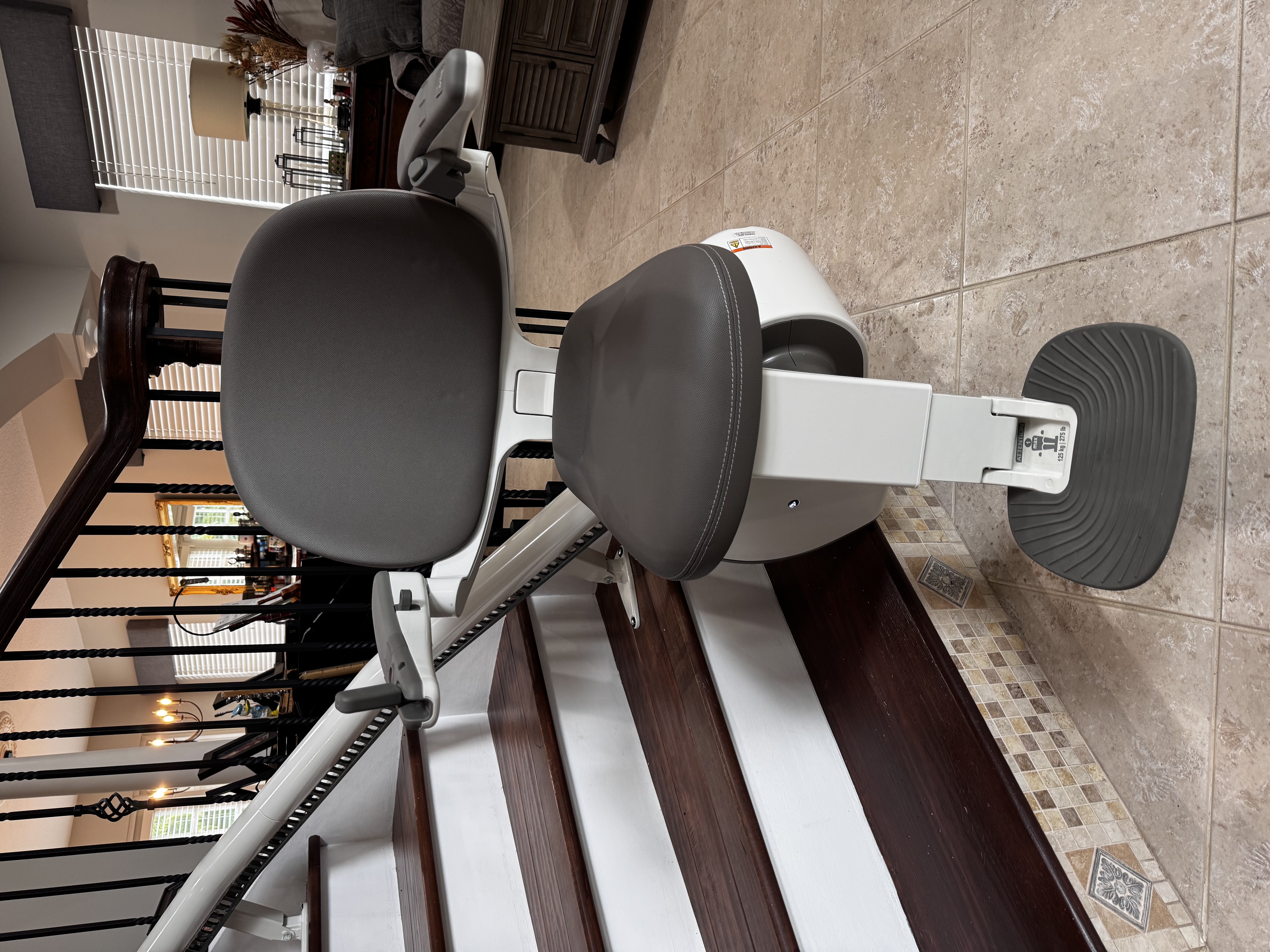
Stop safely and assess the situation
Keep your hands and feet inside the chair and check that you are seated fully back with any available restraint secured. Look for smoke, water, debris, unusual movement, or anything blocking the rail. If the chair is stopped in a safe position, take a moment to decide whether continuing is appropriate.
If another person is nearby, tell them what happened. Avoid standing up on the stairs unless remaining in the chair creates a greater immediate danger.
Complete the ride if the lift is operating normally
If the chair moves smoothly, the controls respond, and the route is clear, you may be able to finish the trip using the remaining battery. Use the controls normally and avoid repeatedly starting and stopping the lift.Once you reach a landing, park the chair where the manufacturer recommends.
Do not make unnecessary extra trips while the home is still without electricity. Saving the remaining charge can matter if you need to return later.
Follow the manufacturer’s emergency procedures
Some equipment may include manual or emergency procedures for a stalled chair, but the correct method is model-specific. Read the user instructions before an outage if possible, and keep them somewhere easy to reach. Never improvise by pulling on the chair, rail, or motor.
If you are unsure what a control or release does, call a qualified service professional or emergency services when there is an immediate safety concern. A written procedure is much easier to follow than a guess made in the dark.
When to avoid using the stairlift
Do not use the lift if the rail, stairs, or landing is wet, obstructed, damaged, or exposed to an electrical hazard. You should also avoid travel if the chair is making unfamiliar noises, stopping unexpectedly, or failing to respond consistently. These signs can indicate a problem beyond the power outage itself.
If the stairway is unsafe, remain where you are if possible and ask for help. A battery-powered lift is not a substitute for a safe route.
How to prepare a stairlift for Florida power outages
Florida weather can bring heavy rain, strong winds, lightning, and outages that last longer than expected. Preparation is mostly practical: keep the equipment ready, know what its alerts mean, and decide how you will manage essential movement if electricity is unavailable for an extended period.
You do not need to wait for a named storm to make a plan. A short checklist reviewed with family members or caregivers can reduce confusion when conditions change quickly.
Keep the stairlift charger powered and park correctly
Keep the stairlift’s charger connected to a working outlet and park the chair at its designated charging position, following the manufacturer’s instructions.Check that the equipment is connected as directed and that the outlet or charging point has not been switched off. Do not use an extension cord or change the electrical setup unless the manufacturer or a qualified professional says it is appropriate.
If the chair is parked away from its charging point, return it according to the equipment instructions when it is safe to do so. Regular charging habits are more useful than trying to prepare at the last minute.
Check for warning lights and battery-related alerts
Warning lights, tones, or messages can signal a low battery, a charging issue, or another condition that deserves attention. Make sure you know what the indicators mean before severe weather arrives. If an alert remains after the chair is parked correctly and the charger is connected to power, arrange an inspection rather than assuming it will clear on its own.
A quick pre-storm check can include these simple steps:
- Confirm the chair is at its designated charging position and that the charging indicator appears normal.
- Look for warning lights, tones, or error messages.
- Check that the rail and stairway are free of stored items.
- Keep the user instructions and service contact information nearby.
This routine will not eliminate every equipment problem, but it can reveal a charging concern while you still have time to address it.
Plan for hurricanes, tropical storms, and extended outages
During hurricane season, consider where you will stay if one floor becomes difficult to access. Keep medications, water, a phone charger, mobility aids, and other essentials on the floor where the user is most likely to remain. If evacuation is possible, follow local emergency guidance rather than relying on a stairlift as an evacuation device.
Power-outage risks vary across Florida, so your emergency plan should reflect your home, household, mobility needs, and local emergency guidance.
Keep essential contact and mobility information accessible
Write down the equipment model if known, the installer or service contact, emergency contacts, and any relevant mobility information. Store the list in a location that is easy to reach without internet access. Family members and caregivers should know where it is and what symptoms mean that the lift should remain unused.
Clear information is especially helpful if the person who usually manages the equipment is away during a storm. It also gives a technician a better starting point if service becomes necessary.
Battery-powered stairlift limitations homeowners should understand
A stairlift’s batteries provide temporary operating power during an outage, but they have limits. They do not restore household electricity, power lights, or keep other accessibility equipment operating.
Understanding those limits helps you avoid using the lift more often than necessary and gives your family time to arrange another solution if the outage continues.
Why a stairlift’s batteries are not the same as a generator
A stairlift’s rechargeable batteries power only the lift for a limited period. A generator is a separate home power source that requires its own equipment, fuel or energy supply, installation, and safety procedures. One should not be assumed to replace the other.
Never connect a stairlift to a generator or alternate power source without guidance from the manufacturer and a qualified electrician. Incorrect connections can damage equipment or create serious hazards.
How frequent outages can affect battery performance
Repeated outages may use up the available charge before the battery has a chance to recover. Batteries also age, and a battery that appears to charge may not hold power as well as it once did. This is one reason routine service and attention to warning indicators matter.
If your home experiences frequent interruptions, record when the lift is used and whether its operating time seems shorter. That information can help a professional assess the issue.
What happens if the battery is depleted
A depleted battery may leave the chair unable to travel until normal power returns and the battery has recharged. Depending on the equipment and the circumstances, a technician may need to evaluate the battery or charging system. Do not assume that repeatedly pressing the control will restore power.
Keep an alternative plan for essential movement between floors, particularly if someone in the home cannot safely use the stairs. The plan might involve staying on one level or arranging assistance.
Why homeowners should confirm model-specific specifications
General guidance cannot predict exactly how many trips your stairlift can make during an outage or how long its batteries will last. Those details depend on the installed model and its condition. Before purchase or during service, ask for the current specifications and the recommended charging and maintenance practices.
A simple comparison can help you organize the questions you want answered:
| Question to ask | Why it matters | Who can clarify it |
|---|---|---|
| How does the lift charge? | You need to know how it stays ready between trips. | Installer or manufacturer |
| What indicates low battery power? | Alerts can help you act before the battery is depleted. | Installer or user manual |
| What affects outage runtime? | Staircase length, user weight, battery condition, and frequency of use can affect the number of available trips. | Qualified professional |
| What service is recommended? | Maintenance can identify charging or battery concerns. | Stairlift service provider |
The answers should be written down with your other emergency information. That makes the advice useful when you are tired, worried, or working with limited lighting.
Safety considerations during storms and extended outages
A stairlift can solve one mobility barrier while other storm-related hazards remain. Water, debris, darkness, and damaged electrical equipment can make an otherwise familiar staircase unsafe. Your decision should account for the whole route, not only whether the chair has battery power.
If any part of the route appears unsafe, do not use the stairlift. Wait for assistance rather than risking a fall or electrical injury.
Keep stairways clear of water, debris, and loose objects
Before using the lift, inspect every part of the route. Remove shoes, boxes, decorations, cords, and other loose items from the steps and landings. After a storm, check for water tracked indoors, windblown debris, ceiling leaks, or damage near the staircase.
Do not clean or move heavy debris from a dangerous area if doing so puts you at risk. Ask another adult for help and keep the stairway closed until it is safe.
Avoid using the lift during flooding or electrical hazards
Water near the stairlift, outlet, controls, or electrical equipment is a reason to stop. Do not touch wet electrical components, operate the lift with wet hands, or travel through a flooded area. If you see sparking, smoke, exposed wiring, or structural damage, leave the area if you can do so safely and contact the appropriate emergency professional.
A stairlift should never be treated as permission to cross a flooded landing or approach damaged electrical equipment.
Account for reduced lighting and emergency conditions
A power outage may leave the staircase dark even when the lift is functioning. Keep flashlights or battery-powered lighting available on both floors, but avoid placing cords or loose devices across the stairs. If you use a phone flashlight, keep one hand free and ask for assistance when visibility is poor.
Emergency conditions can also make communication harder. Tell family members where you are before starting a trip and avoid unnecessary travel until conditions improve.
Create an alternative plan for essential movement between floors
Decide in advance where the stairlift user can safely remain if the equipment cannot be used. Place essential supplies on that level and identify who can provide assistance. If stairs are no longer safe, do not attempt to carry someone without proper training and enough help.
Your alternative plan may be temporary, but writing it down removes pressure from a stressful situation. It should also include how you will contact contact 911 or the appropriate emergency service if there is an immediate danger
Choosing a stairlift with outage readiness in mind
Power-outage readiness is one part of choosing equipment for your home. You also need to consider the staircase layout, where the lift will be installed, who will use it, and how the equipment will be serviced. A professional assessment can evaluate those details along with how the stairlift’s battery system performs during an outage.
As you compare options, ask for clear explanations rather than relying on a generic promise that every model will perform the same way.
Compare straight and curved stairlift requirements
Straight stairlifts are generally intended for standard straight staircases. Curved stairlifts require a rail designed for the individual staircase, including layouts with turns, curves, or intermediate landings. The design and installation requirements can affect the time needed before the equipment is ready.
NewDay Mobility provides straight stairlifts for standard straight staircases and custom curved stairlifts for more complex layouts. Current equipment, design, and scheduling details should be confirmed for your home.
Ask about battery behavior and charging during an outage
Ask how the specific lift charges, where its charging points are located, what happens when utility power stops, and how low-battery alerts appear. Also ask what you should do if the chair stops between floors. These questions are useful before you sign an agreement, not only after a storm.
Request the user instructions in a format you can read easily. Make sure a family member or caregiver understands the same emergency steps.
Consider indoor versus outdoor installation conditions
An outdoor stairlift faces rain, humidity, salt air, heat, and debris in ways an indoor lift does not. The installation location and equipment must be appropriate for the exterior staircase and local conditions. You should ask how weather exposure affects cleaning, inspection, charging, and service.
For exterior access to a porch, garage, or entrance, review the available outdoor stairlift options and discuss the actual conditions at your property. Do not assume an indoor unit is suitable outside.
Match the equipment to the user and staircase
The right choice depends on the user’s mobility needs, the staircase width and configuration, indoor or outdoor use, weight capacity, desired features, and installation conditions. Comfort and control placement matter just as much as the rail route. If more than one person may use the lift, explain each person’s needs during the assessment.
A professional recommendation should be based on your home and the person who will use the equipment. That approach is more reliable than choosing solely by a general product description.
Maintenance and professional support after an outage
A severe storm is a sensible time to check the equipment, even if the lift appears to be working. Water, debris, voltage changes, and repeated battery use may create problems that are not immediately obvious. A careful inspection can help identify concerns before the next trip.
Keep records of unusual behavior, alerts, and the date of the outage. Those details make it easier to explain what happened to a service professional.
Have the stairlift inspected after severe weather
Arrange an inspection if the stairlift was exposed to water, outdoor debris, lightning-related electrical problems, extended use during an outage without normal recharging Outdoor installations deserve particular attention after heavy rain and high winds. Do not remove covers or attempt electrical repairs yourself.
A professional can advise whether the equipment is safe to continue using and whether the battery or charging system needs attention. Follow the manufacturer’s instructions while you wait.
Recognize signs that service may be needed
Stopping unexpectedly, unusual noises, inconsistent controls, failure to charge, and warning lights should not be ignored. A chair that moves more slowly or travels fewer trips than usual may also deserve an evaluation. Write down when the problem occurs and whether utility power was available or the home was experiencing an outage.
NewDay Mobility provides stairlift service and repair, and homeowners can request stairlift service when an outage or storm reveals a concern. Current availability and the appropriate next step should be confirmed directly.
Understand the value of professional installation
A proper installation connects the equipment to the staircase, charging arrangement, and user’s needs. It also gives you an opportunity to learn normal operation, warning indicators, and emergency procedures before you need them. This is particularly useful for families caring for an older adult who may not be comfortable with new controls.
NewDay Mobility provides professional stairlift installation and continued service after installation. The exact equipment, timing, and installation requirements depend on the staircase, product, location, inventory, and scheduling.
Ask NewDay Mobility about service, repairs, and current equipment options
When you speak with a provider, share your staircase type, indoor or outdoor location, user requirements, recent outage history, and any warning messages. Ask which current equipment may fit, how the battery system is expected to operate, and what support is available after installation.
NewDay Mobility serves homeowners throughout its Florida service area with stairlift and home mobility services. A direct conversation can give you current information without assuming that every model or installation has the same specifications.
NewDay Mobility provides stairlift service and repair for equipment and models it supports. Homeowners can request service when an outage or storm reveals a concern.
Conclusion
Most modern stairlifts operate on rechargeable batteries and can continue working temporarily during a Florida power outage Keep the equipment charged, prepare for storms, avoid electrical and flooding hazards, and arrange professional help when performance changes. With a backup plan and clear instructions, you can make a more confident decision about mobility between floors.
Frequently Asked Questions
Do stairlifts work during a power outage?
Many stairlifts can continue operating temporarily from a rechargeable battery when household electricity fails. The available travel time varies by model, battery condition, charging history, staircase, and usage.
How many trips can a stairlift make during an outage?
There is no universal number. A fully charged battery may support multiple trips, but longer stairs, frequent use, an aging battery, and other equipment factors can reduce the available reserve.
Should a stairlift remain plugged in all the time?
Follow the manufacturer’s charging instructions. Keep the charger connected to a working outlet and park the chair at its designated charging position. If it does not appear to charge or displays an alert, contact a qualified stairlift professional.
Can a stairlift be used during a hurricane?
Follow local emergency guidance and avoid unnecessary travel during severe weather. Use the stairlift only when the staircase, landings, lift, and surrounding electrical area are dry, clear, and safe. Never use it during flooding, exposed wiring, structural damage, or other hazardous conditions.
What should you do if a stairlift stops between floors?
Remain seated and follow the model-specific emergency instructions if you know them. Do not force the chair or attempt an unfamiliar release; contact a qualified professional or emergency services when there is an immediate danger.
Is a stairlift battery the same as a generator?
No. A stairlift battery provides temporary power for the lift, while a generator is a separate system intended to supply electricity to selected household equipment under its own safety requirements.
When should a stairlift battery be inspected?
Arrange an inspection if the lift travels fewer trips than usual, fails to charge, shows warning lights, stops unexpectedly, or behaves differently after an extended outage or severe weather. A professional can determine whether the battery, charger, or another component needs attention.