
Key Takeaways
A stairlift is secured to the stair treads rather than the walls, so professional installation typically requires only a small number of mounting points and leaves the home largely intact.
- Small attachment holes or carpet impressions may remain after removal.
- Professional measurement and installation help reduce avoidable damage.
- Straight, curved, and outdoor stairlifts suit different staircase layouts.
- Florida humidity, rain, heat, and existing wear deserve attention.
- Ask about attachment points, removal, service, and warranty coverage before you decide.
Do stairlifts damage stairs?
The short answer is usually no, not in the serious structural sense most homeowners fear. A stairlift does require a secure installation, but the work is normally planned around the staircase rather than the adjacent wall. You may see minor marks after removal, especially on wood or carpet, so it helps to separate ordinary installation traces from meaningful damage.
How stairlift rails attach to the staircase
A stairlift rail is generally fixed to the stair treads with brackets and fasteners. It is not normally attached to the wall or banister, which allows the rail to follow the staircase while keeping those nearby surfaces separate from the installation. The installer needs to locate sound material beneath the tread surface and position the rail so the lift is stable without unnecessarily obstructing the walking path.
A useful way to think about the work is to distinguish the attachment point from the visible rail. The rail carries the lift, while the brackets transfer the load into the stairs. That is why an assessment of tread condition and staircase construction matters before anyone begins drilling.
| Installation feature | What it affects | What you should ask |
|---|---|---|
| Tread-mounted brackets | The stair surface and the rail position | Where will each bracket sit? |
| Fasteners | Small mounting holes in the stair treads | How will existing damage be handled? |
| Rail alignment | Clearance for the rider and other users | Will the stairs remain practical to walk on? |
| Removal plan | Possible holes or surface marks | What restoration may be needed later? |
This simple breakdown can make a consultation less intimidating. A professional installer should be able to show you the proposed attachment points and explain why each one is suitable for your staircase.
How Professional Installation Helps Protect Your Stairs
Professional installation begins with accurate measurements, a careful inspection of the staircase, and a plan for positioning the rail. A certified installer can identify weak or worn areas, confirm clearances, and place the mounting brackets in structurally sound locations. NewDay Mobility provides professional stairlift installation and service, with equipment selected for the staircase, rider, and installation requirements.
That process does not mean every home is identical or that no visible trace can ever remain. It means the work is approached deliberately instead of relying on guesswork or a do-it-yourself fit. Proper testing after installation also helps confirm that the lift operates as intended and that the stairway remains usable for everyone in the household.
The difference between cosmetic changes and serious damage
Cosmetic changes are usually limited to small screw holes, slight carpet impressions, or marks where a bracket rested. On a wood staircase, a hole may be visible when the lift is removed; on carpet, the pile may show a temporary or lasting impression. These are different from cracked structural members, loose treads, or damage that affects the safety of the staircase.
You should ask the installer to document existing marks before work begins. That small step creates a shared record and makes it easier to discuss what is new, what was already present, and what removal might involve. Clear expectations protect your home and make the decision more comfortable for you and your family.
When an inspection may be necessary before installation
An inspection is especially sensible if the stairs flex, creak unusually, show water damage, or have loose coverings. It may also be needed when the staircase has been remodeled, when the underside is inaccessible, or when a landing leaves very little room for the rail and rider. The goal is not to complicate the project; it is to make sure the proposed attachment points are appropriate.
If a problem is found, the right response may be repair, a revised rail position, or a different accessibility solution. Ask for a written explanation of any recommended preparation before approving installation, particularly if you are helping an older parent make the decision.
What parts of the stairs are affected during installation?
Most of the work is concentrated around the stair treads and the rail path. Walls, banisters, trim, and nearby flooring are usually clearance concerns rather than primary attachment surfaces. Understanding those distinctions helps you inspect the proposal without assuming that every nearby surface will be altered.
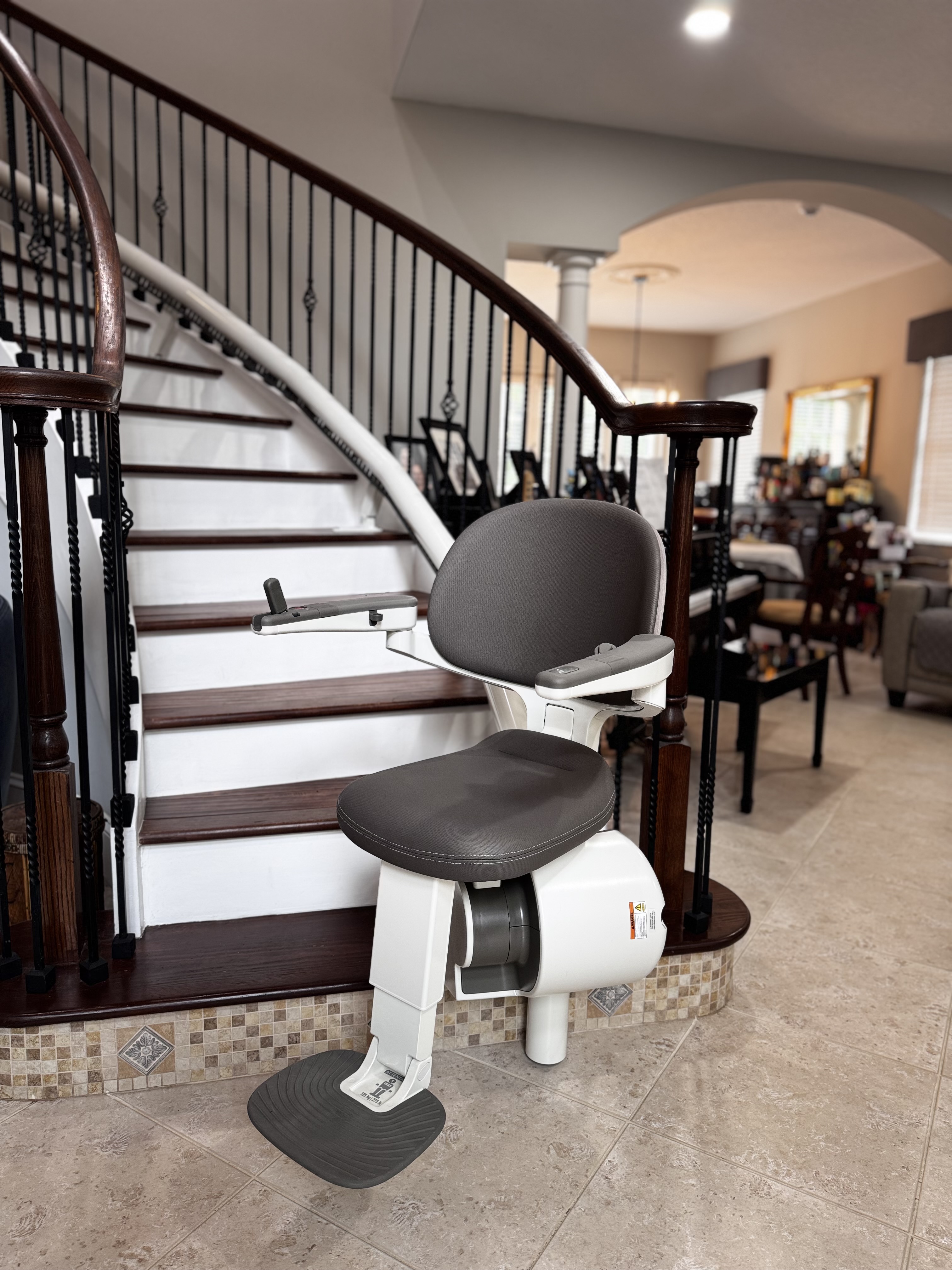
Treads, risers, and landing areas
The treads are typically the main points of contact because brackets need a stable surface. Risers may influence available clearance, but they are not automatically drilled or removed. At the top and bottom, the installer also has to consider where the chair parks, how you approach it, and whether a landing or doorway changes the safest rail position.
A good assessment should account for the whole route, not just the straight run between two floors. It should consider transfers, walking space, and whether another person can still use the stairs comfortably. Those details are often more important to daily life than the lift’s appearance from across the room.
Walls, banisters, and nearby trim
Because the rail is generally supported from the treads, the wall is usually a boundary to work around rather than the place where the rail is fixed. Banisters and trim can still affect clearance, especially on narrow stairs or at a turn. An installer may need to account for their shape and position without removing them.
Before installation, walk the staircase with the assessor and point out anything you want preserved. That could include a handrail, a decorative molding, or a frequently used doorway near the landing. Raising those concerns early gives the installer a chance to plan around them.
Flooring and other surrounding surfaces
Carpet, tile, wood flooring, and transition strips can affect how the stairlift is approached and parked. Installation may leave a small impression in carpet beneath a bracket, while hard surfaces can show a small hole after removal. Nearby flooring may also need protection while equipment and tools are carried through the home.
Ask how the crew will protect the surrounding area and whether any temporary coverings are included in the work plan. You can also ask what cleaning or minor patching would be appropriate if the lift is later removed. These questions help you understand the complete installation process, not only the equipment itself.
What happens when a stairlift is removed
Removal usually reverses the installation process: the rail and brackets come away, and the remaining attachment points are assessed. The result depends on the stair material, the condition of the carpet or wood, and how long the equipment was installed. A removal discussion is worthwhile if you rent your home, may move, or expect your accessibility needs to change.
For wood, small holes may require filling and refinishing; for carpet, the pile may need grooming or replacement in a localized area. Get the likely removal process in writing before purchase so you know which tasks are included and which would be your responsibility..
How stairlift type and staircase design affect installation
The shape and setting of your staircase determine how the rail can be fitted. A straight indoor flight is generally simpler than a staircase with turns, intermediate landings, or exterior exposure. If you are comparing options, a straight versus curved guide can help you frame the questions you want answered during an in-home assessment.
Straight stairlifts for standard staircases
Straight stairlifts are intended for standard straight staircases and generally use a standardized rail fitted along the stair run. They can still require careful planning around a doorway, landing, handrail, or limited parking space. The staircase may be straight while the installation conditions are not simple, so measurements remain important.
NewDay Mobility offers select straight stairlifts starting at $3,990 installed. Final pricing depends on the model, rail length, staircase, selected options, location, installation requirements, and current availability. A personalized quote is more useful than a general online estimate because it reflects your home.
Curved stairlifts for turns and intermediate landings
Curved stairlifts are designed for staircases with turns, curves, intermediate landings, or more complex layouts. Their rail must be designed for the individual staircase, so the process involves more detailed measurement and planning than a typical straight installation. That customization can help the lift follow the route without forcing a straight rail into an unsuitable space.
NewDay Mobility offers custom curved stairlift solutions, with pricing provided through a personalized quote rather than a fixed amount. If your staircase winds around a corner or changes direction, ask how the proposed rail will pass the landing and how much walking clearance will remain.
Outdoor stairlifts and exterior stair conditions
Outdoor stairs introduce different concerns: rain, direct sun, humidity, drainage, surface wear, and the condition of the landing where the lift will park. The structure may also be exposed to salt air near the coast or to repeated wet-and-dry cycles. A Florida outdoor stairlift guide can help you compare a stairlift with ramps or a vertical platform lift before committing to one approach.
The lift should be selected for exterior use, and the installer should review the stairs as they exist today rather than assuming an indoor installation can simply be moved outside. Look closely at cracked concrete, slippery surfaces, corrosion, and water that collects near the bottom or top of the stairs.
Narrow, spiral, and unusually configured staircases
Narrow and spiral staircases require careful attention to usable walking width, turning space, banisters, and obstructions. A lift may fit physically yet leave an awkward route for other household members, so the consultation should consider how everyone uses the stairs. A narrow-staircase assessment is particularly helpful when a radiator, window, doorway, or unusual wall angle is involved.
For complex layouts, expect the installer to discuss clearance and rail position in plain language. Do not rely on a measurement taken from one point alone; the chair, rider, rail, and other users all need room throughout the route.
What factors can increase the risk of damage?
Although tread-mounted installation is typically minimally invasive, the condition of the staircase, the accuracy of the measurements, and the installer’s experience can affect the result. Identifying potential problems before equipment is ordered helps protect the stairs and supports a secure installation.
Weak, damaged, or uneven stair treads
Rot, splitting, movement, water damage, or an unusually thin tread can make an attachment point unsuitable. Uneven surfaces can also make it harder to align brackets and keep the rail stable. If a tread is questionable, ask whether it should be repaired or reinforced first rather than allowing the installer to work around the issue without explanation.
Existing damage should be photographed and discussed during the assessment. That protects both the homeowner and the installer from confusion later, and it gives you a clearer idea of the project’s true scope.
Loose railings and inadequate structural support
A loose handrail does not necessarily prevent a stairlift installation, but it deserves attention because you may still depend on it when walking. The installer should consider the relationship between the rail, the banister, and the available walking path. If the staircase has broader structural concerns, a qualified professional may need to address them before the lift is fitted.
Do not treat a stairlift as a substitute for repairing an unsafe staircase. The lift and the stairs serve different purposes, and both should be reliable for the people using them.
Tight clearances and complex staircase layouts
Tight clearances increase the chance of scuffed walls, obstructed walking space, or a rail position that feels awkward in daily use. Turns, landings, low ceilings, and doors near the route can add similar complications. These conditions do not necessarily rule out a stairlift, but they make accurate measurement and careful positioning more important.
Ask to see where the chair will travel and park, not just where the rail begins. A simple walkthrough with the installer can reveal conflicts that are difficult to spot from a tape measure alone.
Incorrect measurements or improper installation
Incorrect measurements can lead to a poor fit, unnecessary repositioning, or attachment points that do not suit the staircase. Improper installation can create both property concerns and safety concerns, which is why professional measurement, installation, and testing should be included in the purchase process—not treated as an afterthought.
Before work begins, confirm who will measure, install, test, and support the equipment. If a quote leaves those responsibilities vague, ask for clarification before signing.
How Florida conditions can affect stairlift installation
Florida homes vary widely, from newer inland construction to older coastal properties and outdoor steps exposed to intense weather. Climate does not automatically mean a stairlift will damage your stairs, but it can change the condition of the materials and the maintenance the installation requires. Your assessment should consider both the staircase and the environment around it.
Humidity, moisture, and indoor wood components
Indoor humidity can affect wood over time, particularly where ventilation is limited or a leak has gone unnoticed. Look for swelling, soft areas, staining, or movement before an installer evaluates attachment points. A dry-looking tread can still have a history of moisture exposure, so mention past leaks or repairs.
The practical question is whether the material can safely support the planned attachments. Addressing moisture or wood damage first may protect the staircase and prevent a rushed installation decision.
Outdoor stairs exposed to rain and heat
Exterior stairs face rain, heat, ultraviolet exposure, and sometimes salt air. Concrete can crack, wood can weather, and metal components can corrode if water is allowed to remain around them. Drainage and the condition of the landing matter as much as the visible stair surfaces.
During an outdoor assessment, ask how the proposed equipment is intended to handle the setting and what care is expected from you. NewDay Mobility provides outdoor stairlift solutions as part of its Florida mobility services, with the appropriate option depending on the staircase and installation conditions.
Older Florida homes and existing staircase wear
An older home may have repaired treads, uneven risers, narrow landings, or several layers of flooring. None of those features automatically disqualifies the staircase, but they can change where and how the rail is attached. Existing wear should be recorded before work so repair needs are not mistaken for installation damage.
If you live in an older property, allow extra time for the assessment and ask whether any preparation is recommended. A careful plan is more reassuring than a promise made before anyone has seen the stairs.
Local site conditions and service-area considerations
Site conditions can vary across Florida, even when staircases look similar. Location may affect scheduling, travel, product availability, and exterior exposure. NewDay Mobility serves homeowners across Florida; call to confirm current availability and installation timing for your specific address
Before arranging work, review these practical details:
- Whether your county and specific address are within the current service area.
- Whether the staircase is indoors, outdoors, or partly exposed.
- Whether weather could affect access or the planned installation date.
- What service and repair support is available after installation.
These checks do not replace a staircase assessment, but they help set realistic expectations. For a broader decision framework, review guidance on choosing a stairlift safely before comparing quotes.
How to reduce damage concerns before choosing a stairlift
The best way to feel confident is to make the installation plan visible before you approve it. Ask direct questions, request a written quote, and discuss what happens if your needs or housing situation changes. A trustworthy provider should be comfortable explaining both the benefits and the limitations of the proposed installation.
Ask for a professional staircase assessment
A professional assessment should look at the stair shape, tread condition, landing space, clearances, and your everyday route through the home. It should also consider whether a straight, curved, or outdoor lift is appropriate. Bring another family member or caregiver if they will help with the decision, since they may notice practical concerns you overlook.
Ask the assessor to identify existing damage and explain any preparation needed. You should leave knowing why the recommended equipment fits your staircase, not simply that it is available.
Confirm the installation plan and attachment points
Request a clear explanation of where the brackets will sit, how the rail will be aligned, and what surfaces will be protected during the work. You can also ask how the installer will handle carpet, trim, banisters, and nearby flooring. If the plan changes on installation day, pause and ask why before approving a different approach.
For a Florida homeowner researching options, you can request an assessment and use the conversation to address damage concerns before ordering equipment. Written details make it easier to compare providers on more than price alone.
Discuss purchasing, future removal, and buy-back options
Purchasing may suit you if you expect to remain in the home and use the stairlift for an extended period. If your future needs are uncertain, ask whether buy-back or removal options may be available. Equipment eligibility, terms, and removal responsibilities can vary, so request the details in writing.
Make removal part of the original conversation. Ask who removes the rail, what happens to mounting holes or carpet impressions, and whether minor restoration is included or separately arranged. NewDay Mobility can explain any currently available removal or buy-back options based on the equipment and circumstances.
Review service, warranty, and current pricing details with the provider
Pricing depends on the staircase, model, rail length, options, location, and installation requirements. Qualifying stairlifts may carry a lifetime warranty, but coverage can vary by product, model, component, and current program. Financing may be available to qualified customers, with approval and applicable terms affecting eligibility.
Ask for current details rather than relying on an old advertisement or a general estimate. A provider should also explain service after installation, response arrangements, and what is included in the quoted work so you can compare the full value of each option.
Conclusion
For most Florida homeowners, the answer to “do stairlifts damage stairs” is that professional installation is designed to be secure and minimally disruptive, though small marks may remain after removal. Reviewing the staircase condition, climate exposure, rail design, attachment points, service terms, and removal plan before choosing a lift gives you a much clearer and calmer path forward.
Frequently Asked Questions
Do stairlifts attach to the wall?
Most stairlifts are designed to attach to the stair treads with brackets rather than to the wall. The exact arrangement depends on the equipment and staircase, so ask the installer to show you the proposed attachment points.
Will a stairlift damage carpet?
Installation may leave a small impression where brackets rest on the carpet, and removal can reveal marks in the pile. The extent depends on the carpet and how long the lift is installed.
Can a stairlift be installed on wooden stairs?
A stairlift can often be installed on wooden stairs when the treads and supporting structure are suitable. Existing rot, splitting, movement, or water damage should be evaluated first.
Can a stairlift be removed later?
Yes, stairlifts can generally be removed, but small holes or surface marks may remain. Ask in advance whether removal and minor restoration are included in your agreement.
Are curved stairlifts more disruptive to install?
Curved stairlifts require a rail designed for the individual staircase, so planning and fabrication can be more involved. The installation should still be assessed around the home’s existing structure and clearances.
Do outdoor stairlifts need special consideration in Florida?
Yes. Rain, heat, humidity, salt air, drainage, and weathered stair materials can all affect the installation environment. The equipment and staircase should both be evaluated for exterior conditions.
What should you ask before installation?
Ask about the rail route, attachment points, existing damage, protection for nearby surfaces, removal, service, warranty coverage, current pricing, and any available financing or buy-back terms. A written explanation helps you compare your options fairly.